2-(Trichloroacetyl)pyrrole → 1-[5-(Trichloroacetyl)-1H-pyrrol-3-yl]propan-1-one
Reaction equation

[Cl:1][C:2]([Cl:11])([Cl:10])[C:3]([C:5]1[NH:6][CH:7]=[CH:8][CH:9]=1)=[O:4].[Cl-].[Cl-].[Cl-].[Al+3]>ClCCl>[Cl:11][C:2]([Cl:1])([Cl:10])[C:3]([C:5]1[NH:6][CH:7]=[C:8]([C:3](=[O:4])[CH2:5][CH3:9])[CH:9]=1)=[O:4]Participants
4
Reactant 2
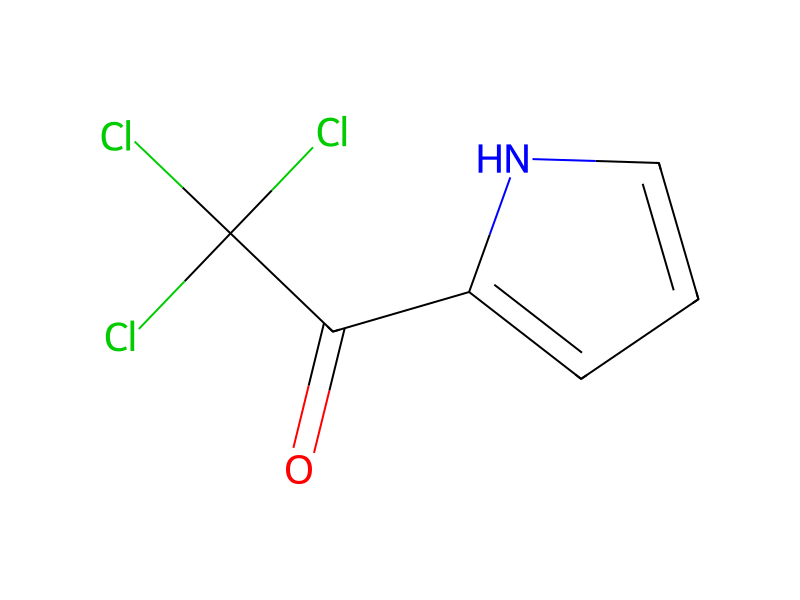

Product 1

Reagents, catalysts & solvents 1

Procedure
In a dry flask, 3-proprionyl chloride (1 equivalent) was combined with 2-trichloroacetyl pyrrole (1 equivalent) in a minimum amount of dichloromethane (DCM). To the resulting solution, at ambient temperature, was added aluminum trichloride (1 equivalent). After 2 hours, the reaction mixture was applied directly onto a silica gel column. Gradient elution with 10% ethyl acetate to 50% ethyl acetate in hexanes provided compound 3.
Workup
- washGradient elution with 10% ethyl acetate to 50% ethyl acetate in hexanes provided compound 3
Sources & evidence
- ORD record
- ord-cdd1c2ef92f641ecbeaca80ea630cf62
- Source dataset
- uspto-grants-2004_06
- Patent number
- US06743791B2
Reaction notes
Loading…