Diisopropylethylamine → 5-Bromo-2-(2-{[2-(trimethylsilyl)ethoxy]methoxy}propan-2-yl)pyridine
Reaction equation

[Br:1][C:2]1[CH:3]=[CH:4][C:5]([C:8]([OH:11])([CH3:10])[CH3:9])=[N:6][CH:7]=1.C(N(CC)C(C)C)(C)C.[CH3:21][Si:22]([CH3:29])([CH3:28])[CH2:23][CH2:24][O:25][CH2:26]Cl>C(Cl)Cl>[Br:1][C:2]1[CH:3]=[CH:4][C:5]([C:8]([CH3:9])([O:11][CH2:26][O:25][CH2:24][CH2:23][Si:22]([CH3:29])([CH3:28])[CH3:21])[CH3:10])=[N:6][CH:7]=1Participants
5

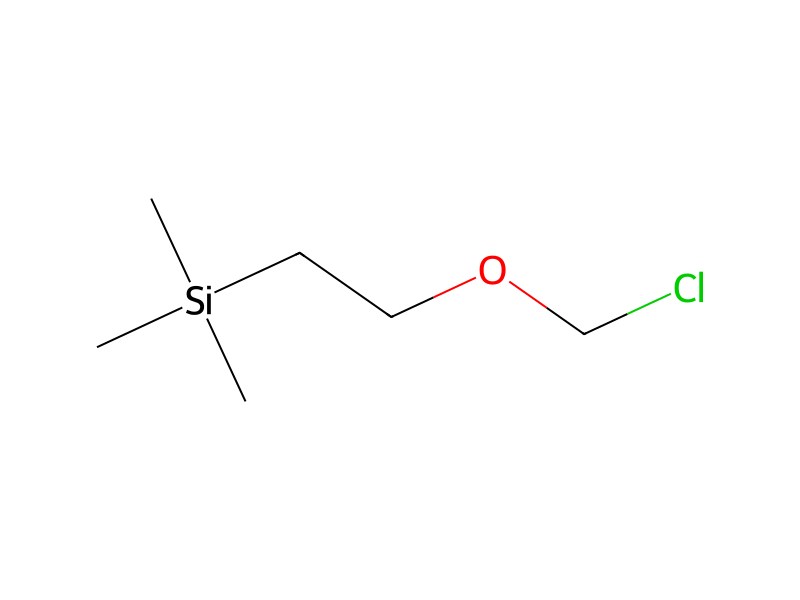



Procedure
To a solution of 5-bromo-2-(1-hydroxy-1-methylethyl)pyridine from Step 1 (14 mmol) in methylene chloride (50 mL) at 0° C. was added N,N-diisopropylethylamine (37.3 mmol) and 2-(trimethylsilyl)ethoxymethyl chloride (15.3 mmol). The resulting mixture was stirred at room temperature for 18 hours, then refluxed for 24 hours. After cooling to room temperature the mixture was quenched with saturated aqueous ammonium chloride solution and partitioned between methylene chloride and water. The crude product from the organic phase was chromatographed on silica gel eluting with 6% ethyl acetate in hexane to afford the 5-bromo-2-(1-methyl-1-{[2-(trimethylsilyl)ethoxy]methoxy}ethyl)pyridine compound.
Workup
- temperaturerefluxed for 24 hours
- temperatureAfter cooling to room temperature the mixture
- customwas quenched with saturated aqueous ammonium chloride solution
- custompartitioned between methylene chloride and water
- customThe crude product from the organic phase was chromatographed on silica gel eluting with 6% ethyl acetate in hexane
Sources & evidence
- ORD record
- ord-6358340ec48e43a3ba2ef2a6fb343f54
- Source dataset
- uspto-grants-2004_06
- Patent number
- US06743802B2
Reaction notes
Loading…