Hydrochloric Acid → HCID 22710891, compound
Reaction equation
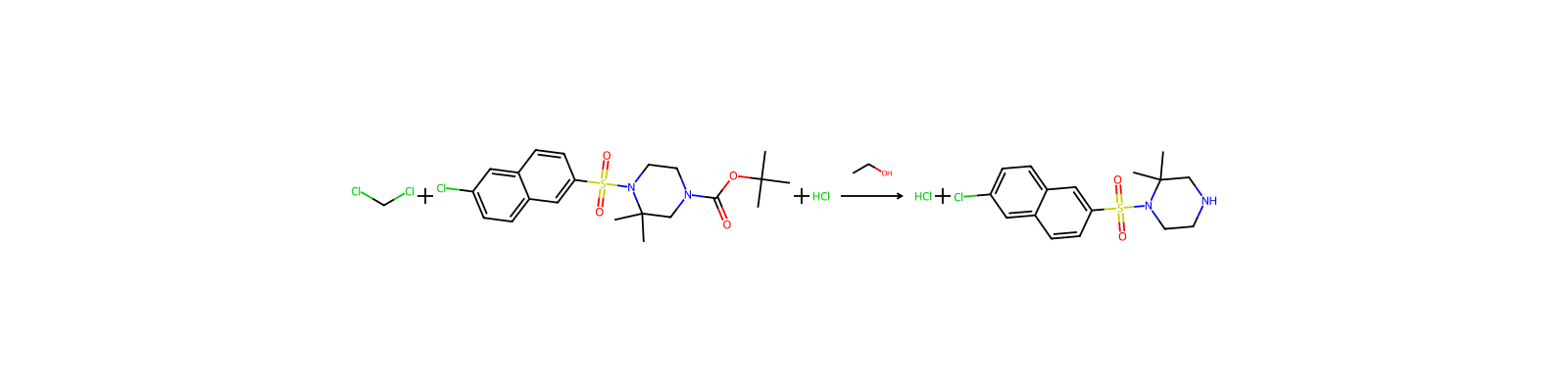
C(Cl)[Cl:2].C(OC([N:11]1[CH2:16][CH2:15][N:14]([S:17]([C:20]2[CH:29]=[CH:28][C:27]3[C:22](=[CH:23][CH:24]=[C:25]([Cl:30])[CH:26]=3)[CH:21]=2)(=[O:19])=[O:18])[C:13]([CH3:32])([CH3:31])[CH2:12]1)=O)(C)(C)C.Cl>C(O)C>[ClH:2].[Cl:30][C:25]1[CH:26]=[C:27]2[C:22](=[CH:23][CH:24]=1)[CH:21]=[C:20]([S:17]([N:14]1[CH2:15][CH2:16][NH:11][CH2:12][C:13]1([CH3:32])[CH3:31])(=[O:18])=[O:19])[CH:29]=[CH:28]2Participants
5
Reactant 3



Product 1

Reagents, catalysts & solvents 1

Procedure
To a methylene chloride solution (0.5 ml) of 4-(tert-butoxycarbonyl)-1-[(6-chloronaphthalen-2-yl)sulfonyl]-2,2-dimethylpiperazine (140 mg) was added a saturated solution (0.5 ml) of hydrochloride in ethanol. The resulting mixture was stirred at room temperature for 14 hours. Ethanol was added to the reaction mixture. After the sufficient removal of hydrochloric acid by azeotropy, the residue was dried using a vacuum pump, whereby the title compound (119 mg) was obtained as a colorless solid.
Workup
- customAfter the sufficient removal of hydrochloric acid by azeotropy
- customthe residue was dried
- customwas obtained as a colorless solid
Sources & evidence
- ORD record
- ord-5bf41e35a2034df1a2604a158769b80f
- Source dataset
- uspto-grants-2004_06
- Patent number
- US06747023B1
Reaction notes
Loading…