Carbon Dioxide → 2-[[4-[(6-Chloronaphthalen-2-yl)sulfonyl]piperazin-1-yl]carbonyl]-6-methyl-4,5,6,7-tetrahydrofuro[2,3-c]pyridine Hydrochloride
Reaction equation

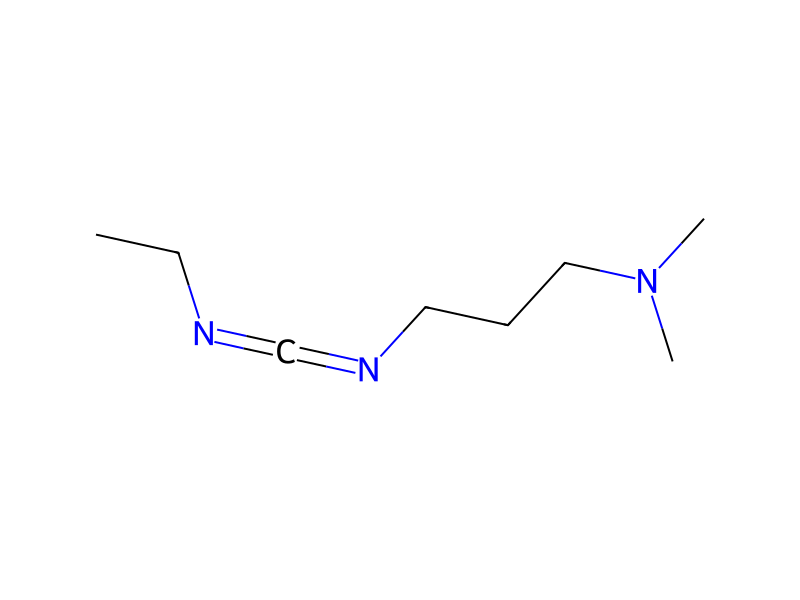
[CH3:1][N:2]1[CH2:7][CH2:6][C:5]2[CH:8]=[CH:9][O:10][C:4]=2[CH2:3]1.[C:11](=[O:13])=O.Cl.[Cl:15][C:16]1[CH:17]=[C:18]2[C:23](=[CH:24][CH:25]=1)[CH:22]=[C:21]([S:26]([N:29]1[CH2:34][CH2:33][NH:32][CH2:31][CH2:30]1)(=[O:28])=[O:27])[CH:20]=[CH:19]2.CN(CCCN=C=NCC)C.ON1C2C=CC=CC=2N=N1.C(N(C(C)C)CC)(C)C>O1CCCC1.C([Li])CCC.CN(C)C=O.Cl.C(O)C.C(Cl)Cl.CCCCCC>[ClH:15].[Cl:15][C:16]1[CH:17]=[C:18]2[C:23](=[CH:24][CH:25]=1)[CH:22]=[C:21]([S:26]([N:29]1[CH2:30][CH2:31][N:32]([C:11]([C:9]3[O:10][C:4]4[CH2:3][N:2]([CH3:1])[CH2:7][CH2:6][C:5]=4[CH:8]=3)=[O:13])[CH2:33][CH2:34]1)(=[O:27])=[O:28])[CH:20]=[CH:19]2Participants
Reactant 6





Product 1

Reagents, catalysts & solvents 6






Conditions
- Temperature
- -78 °C
Procedure
To a solution of 6-methyl-4,5,6,7-tetrahydrofuro[2,3-c]pyridine (58.1 mg) in tetrahydrofuran (3.2 ml), n-butyl lithium (a 1.59N hexane solution, 320 μl) was added at −78° C., followed by stirring for 1 hour and then at 0° C. for 30 minutes. The reaction mixture was cooled to −78° C. and a carbon dioxide gas was introduced thereinto for 1 hour. After the reaction mixture was heated to room temperature over 30 minutes, it was concentrated. To a solution of the resulting residue in N,N-dimethylformamide (6.0 ml), 1-[(6-chloronaphthalen-2-yl)sulfonyl]piperazine hydrochloride (177 mg, 510 μmol) was dissolved, followed by the addition of 1-(dimethylaminopropyl)-3-ethylcarbodiimide (98.0 mg, 511 μmol) and 1-hydroxybenzotriazole (69.0 mg, 511 μmol) at room temperature and then, diisopropylethylamine (185 μl, 1.06 mmol) at 0° C. After stirring overnight at room temperature, the reaction mixture was added with methylene chloride (20 ml) and a saturated aqueous solution (50 ml) of sodium bicarbonate, whereby the organic layer was separated. The resulting organic layer was extracted with methylene chloride (2×10 ml). The organic layers were combined, washed with water (50 ml), dried over anhydrous sodium sulfate and concentrated under reduced pressure. The residue thus obtained was purified twice by preparative thin-layer chromatography on a silica gel (methylene chloride:acetone:methanol=10:5:1). The white solid thus obtained was dissolved in a 1N ethanol hydrochloride solution and the resulting solution was concentrated. After the addition of water, the mixture was concentrated again, whereby the title compound (74.7 mg) was obtained as a white solid.
Workup
- waitat 0° C. for 30 minutes
- waitfor 1 hour
- temperatureAfter the reaction mixture was heated to room temperature over 30 minutes
- concentrationit was concentrated
- customat 0° C
- stirringAfter stirring overnight at room temperature
- customa saturated aqueous solution (50 ml) of sodium bicarbonate, whereby the organic layer was separated
- extractionThe resulting organic layer was extracted with methylene chloride (2×10 ml)
- washwashed with water (50 ml)
- dry with materialdried over anhydrous sodium sulfate
- concentrationconcentrated under reduced pressure
- customThe residue thus obtained
- customwas purified twice by preparative thin-layer chromatography on a silica gel (methylene chloride:acetone:methanol=10:5:1)
- customThe white solid thus obtained
- concentrationthe resulting solution was concentrated
- additionAfter the addition of water
- concentrationthe mixture was concentrated again
Sources & evidence
- ORD record
- ord-c035c5128a1047a0ab876aac3bb4ccfc
- Source dataset
- uspto-grants-2004_06
- Patent number
- US06747023B1
Reaction notes
Loading…