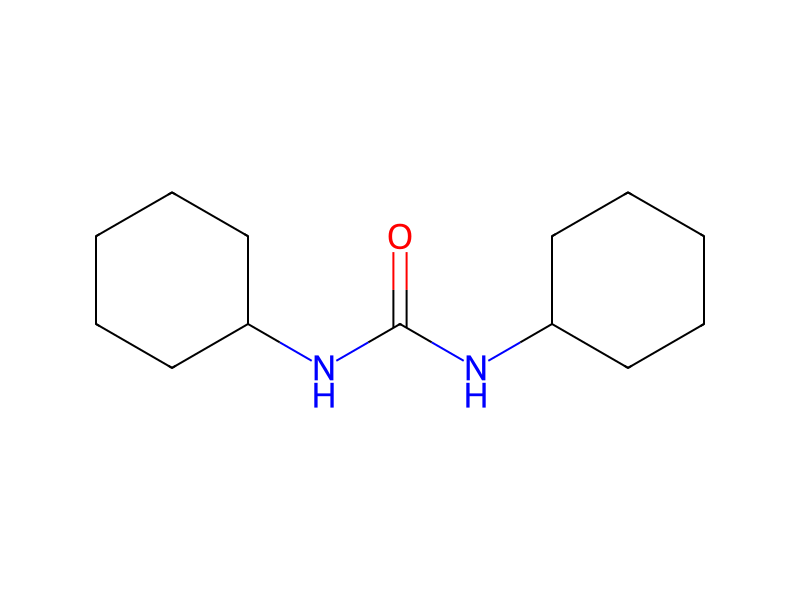
Ethanol → N,N'-Dicyclohexylurea
Reaction equation

C(CC(OC1C=[C:10]([C:14]2[N:15]=[C:16]3[N:20]([CH:21]=2)[C:19]2[CH:22]=[CH:23][CH:24]=[CH:25][C:18]=2S3)[CH:11]=[CH:12][CH:13]=1)=O)(O)=O.C([OH:28])C.C1(N=C=NC2CCCCC2)CCCCC1>O1CCCC1>[CH:19]1([NH:20][C:16]([NH:15][CH:14]2[CH2:10][CH2:11][CH2:12][CH2:13][CH2:21]2)=[O:28])[CH2:18][CH2:25][CH2:24][CH2:23][CH2:22]1Participants
5
Reactant 3



Product 1
Reagents, catalysts & solvents 1

Procedure
To a mixture of 4 g of 2-(m-carboxyacetoxyphenyl)imidazo[2,1-b]benzothiazole, 0.52 g of ethanol, and 50 ml of tetrahydrofuran was added a mixture of 2.3 g of dicyclohexylcarbodiimide and 10 ml of tetrahydrofuran at a temperature below 10° C. Thereafter, the mixture was stirred overnight at room temperature. Dicyclohexyl urea thus formed was filtered off and the filtrate was concentrated under reduced pressure. The residue was applied to silica gel column chromatography (80 ml of silica gel, eluate: a mixture of toluene and ethyl acetate (9:1)) to provide 2.0 g of oily 2-(m-ethoxycarbonylacetoxyphenyl)imidazo[2,1-b]benzothiazole.
Workup
- additionwas added
Sources & evidence
- ORD record
- ord-d527bffdb09447ec874148bbd199ad2e
- Source dataset
- uspto-grants-1984_08
- Patent number
- US04464384
Reaction notes
Loading…