Sodium borohydride → HCID 13200529, compound
Reaction equation

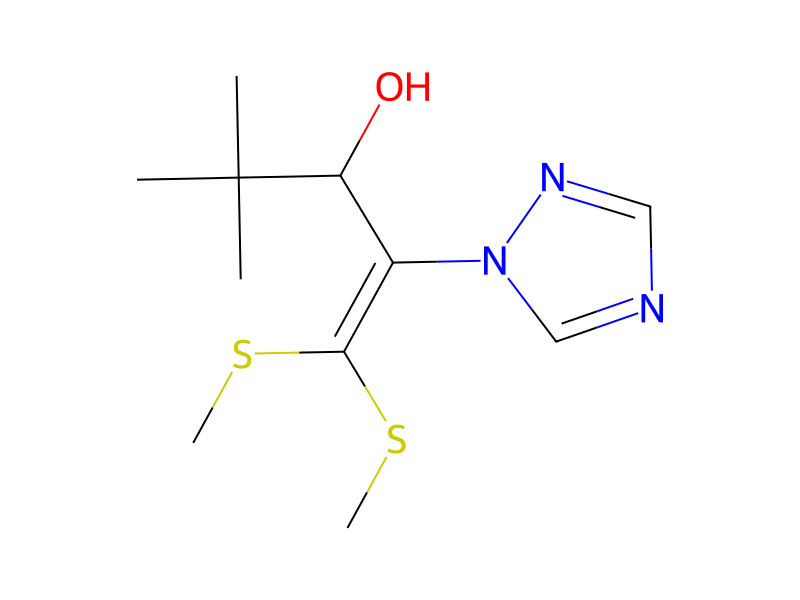
[CH3:1][C:2]([CH3:17])([C:4](=[O:16])[C:5]([N:11]1[CH:15]=[N:14][CH:13]=[N:12]1)=[C:6]([S:9][CH3:10])[S:7][CH3:8])[CH3:3].[BH4-].[Na+]>CO>[CH3:3][C:2]([CH3:17])([CH:4]([OH:16])[C:5]([N:11]1[CH:15]=[N:14][CH:13]=[N:12]1)=[C:6]([S:7][CH3:8])[S:9][CH3:10])[CH3:1]Participants
4
Reactant 2


Product 1
Reagents, catalysts & solvents 1

Procedure
15 g (0.055 mol) of 2,2-dimethyl-5,5-dimethylthio-4-(1,2,4-triazol-1-yl)-pent-4-en-3-one (obtained as described in Example 1) were dissolved in 100 ml of methanol, and 2.1 g (0.055 mol) of sodium borohydride were added at room temperature. The mixture was stirred for a further 30 minutes at 20° to 30° C., and was concentrated. The residue was partitioned between methylene chloride and water. The organic phase was separated off, dried over sodium sulphate and concentrated. 11.9 g (80% of theory) of 2,2-dimethyl-5,5-dimethylthio-4-(1,2,4-triazol-1-yl)-pent-4-en-3-ol of melting point 108° to 111° C. were obtained.
Workup
- concentrationwas concentrated
- customThe residue was partitioned between methylene chloride and water
- customThe organic phase was separated off
- dry with materialdried over sodium sulphate
- concentrationconcentrated
Sources & evidence
- ORD record
- ord-c5fada6f6b00416291b371e3da0800a7
- Source dataset
- uspto-grants-1984_08
- Patent number
- US04465680
Reaction notes
Loading…