p-Toluidine → N-(4-methylphenyl) phenylpropiolamide
Reaction equation

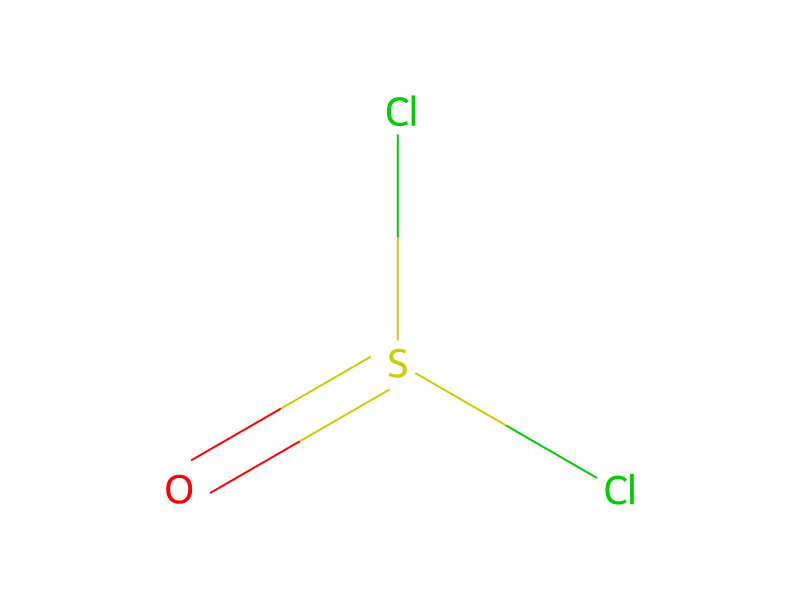
[C:1]1([C:7]#[C:8][C:9]([OH:11])=O)[CH:6]=[CH:5][CH:4]=[CH:3][CH:2]=1.S(Cl)(Cl)=O.[NH2:16][C:17]1[CH:22]=[CH:21][C:20]([CH3:23])=[CH:19][CH:18]=1>C1C=CC=CC=1>[CH3:23][C:20]1[CH:21]=[CH:22][C:17]([NH:16][C:9](=[O:11])[C:8]#[C:7][C:1]2[CH:2]=[CH:3][CH:4]=[CH:5][CH:6]=2)=[CH:18][CH:19]=1Participants
Reactant 3


Product 1

Reagents, catalysts & solvents 1

Procedure
A mixture of 14.61 g (0.10 mole) phenylpropiolic acid, 14.28 g (0.12 mole) thionyl chloride and 50 mL benzene was stirred and heated between 60°-70° C. for 3 hrs. The reaction was allowed to cool to room temperature and solvent was evaporated. The reaction vessel was charged with 50 mL of fresh benzene and the mixture cooled in an ice bath. Added next, dropwise in 50 mL benzene, was 21.43 g (0.20 mole) of 4-toluidine. After addition was complete, the ice bath was removed and the mixture stirred at room temperature for one hour. The mixture was poured into 200 mL cold water and the layers were separated. The aqueous layer was extracted with three 100 mL portions of ethyl acetate. The combined organic layers were then washed sequentially with 100 mL portions of 5% aqueous hydrochloric acid, water, 5% aqueous sodium carbonate and water. The organic layer was dried, filtered and solvent was evaporated from the filtrate. The resulting solid was recrystallized twice from ethanol/water to provide 11.58 g (49.20 mmol, 49%) N-(4-methylphenyl) phenylpropiolamide as a white powder, mp=139°-141°. NMR (CDCl3 /TMS): 2.35 (S, 3H), 7.1-7.6 (m, 10H). IR (Nujol):2214, 1636. High resolution mass spectrum: Calculated; 236. 107539. Measured; 236. 107101. Anal. calcd. for C16H13NO: C 81.70, H 5.53, N 5.96; Found C 3581.55, H 5.40, N 6.05.
Workup
- temperatureheated between 60°-70° C. for 3 hrs
- customsolvent was evaporated
- additionThe reaction vessel was charged with 50 mL of fresh benzene
- temperaturethe mixture cooled in an ice bath
- additionAdded next, dropwise in 50 mL benzene
- additionAfter addition
- customthe ice bath was removed
- stirringthe mixture stirred at room temperature for one hour
- additionThe mixture was poured into 200 mL cold water
- customthe layers were separated
- extractionThe aqueous layer was extracted with three 100 mL portions of ethyl acetate
- washThe combined organic layers were then washed sequentially with 100 mL portions of 5% aqueous hydrochloric acid, water, 5% aqueous sodium carbonate and water
- customThe organic layer was dried
- filtrationfiltered
- customsolvent was evaporated from the filtrate
- customThe resulting solid was recrystallized twice from ethanol/water
Sources & evidence
- ORD record
- ord-7903100ebffb41d28470c7faa6571b6f
- Source dataset
- uspto-grants-1995_05
- Patent number
- US05411977
Reaction notes
Loading…