Water → Ethyl p-(6-Bromohexyloxy)benzoate
Reaction equation

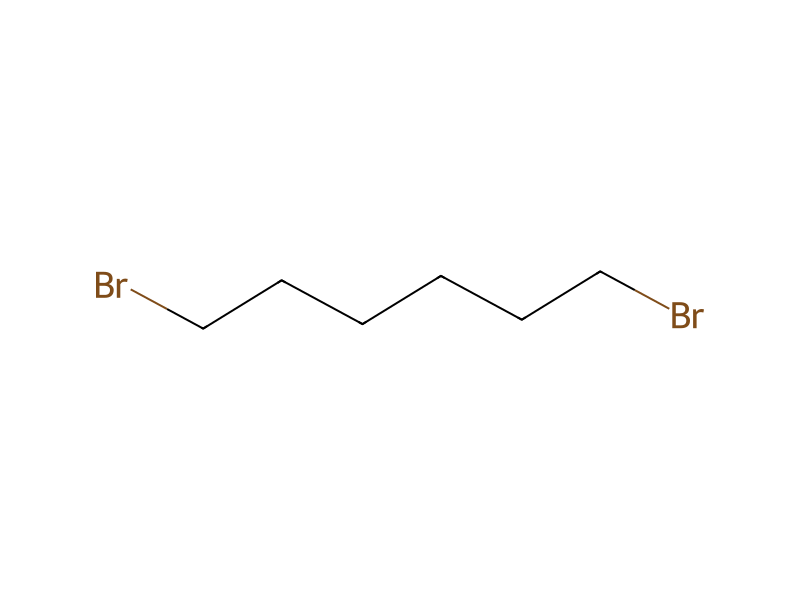
[OH:1][C:2]1[CH:12]=[CH:11][C:5]([C:6]([O:8][CH2:9][CH3:10])=[O:7])=[CH:4][CH:3]=1.[OH-].[K+].[Br:15][CH2:16][CH2:17][CH2:18][CH2:19][CH2:20][CH2:21]Br.O>CS(C)=O>[Br:15][CH2:16][CH2:17][CH2:18][CH2:19][CH2:20][CH2:21][O:1][C:2]1[CH:3]=[CH:4][C:5]([C:6]([O:8][CH2:9][CH3:10])=[O:7])=[CH:11][CH:12]=1Participants
6
Reactant 4



Product 1

Reagents, catalysts & solvents 1

Procedure
To a solution of 232 g of ethyl 4-hydroxybenzoate [XII; Alk=C2H5 ] in 1.2 liters of dimethylsulfoxide was added 100 g of potassium hydroxide. The mixture was stirred for five minutes, 678 g of 1,6-dibromohexane was then added, and the mixture stirred for four hours during which an exothermic reaction occurred (max. temp. 46° C.). The reaction mixture was added to 1500 ml of water and extracted three times with 800 ml of cyclohexane. The cyclohexane layer was washed with 800 ml of water, 200 ml 2N potassium hydroxide and 800 ml concentrated sodium chloride solution, then filtered and concentrated in vacuo. The residue was triturated with ether to give 328.1 g of ethyl 4-(6-bromohexyloxy)benzoate.
Workup
- stirringthe mixture stirred for four hours during which
- customan exothermic reaction
- custom(max. temp. 46° C.)
- extractionextracted three times with 800 ml of cyclohexane
- washThe cyclohexane layer was washed with 800 ml of water, 200 ml 2N potassium hydroxide and 800 ml concentrated sodium chloride solution
- filtrationfiltered
- concentrationconcentrated in vacuo
- customThe residue was triturated with ether
Sources & evidence
- ORD record
- ord-7282f901de3d4d6c8715599be6f89aec
- Source dataset
- uspto-grants-1991_03
- Patent number
- US05002960
Reaction notes
Loading…