Triphenylphosphine → HCID 21345250, compound
Reaction equation

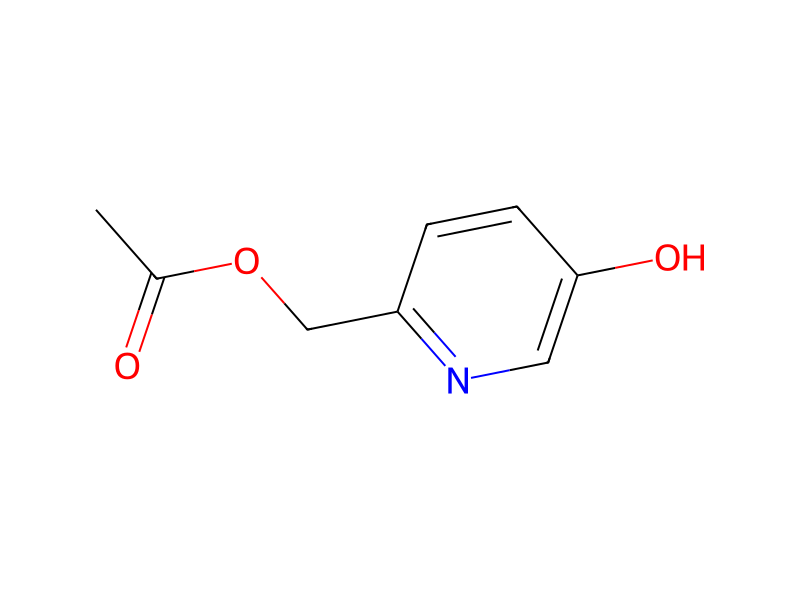
[C:1]([O:5][C:6]([N:8]1[CH2:11][CH2:10][C@H:9]1[CH2:12][OH:13])=[O:7])([CH3:4])([CH3:3])[CH3:2].C([O:17][CH2:18][C:19]1[N:24]=[CH:23][C:22](O)=[CH:21][CH:20]=1)(=O)C.C1(P(C2C=CC=CC=2)C2C=CC=CC=2)C=CC=CC=1.CCOC(/N=N/C(OCC)=O)=O.[OH-].[K+]>CO>[OH:17][CH2:18][C:19]1[N:24]=[CH:23][C:22]([O:13][CH2:12][C@@H:9]2[CH2:10][CH2:11][N:8]2[C:6]([O:5][C:1]([CH3:4])([CH3:3])[CH3:2])=[O:7])=[CH:21][CH:20]=1Participants
Reactant 5




Product 1

Reagents, catalysts & solvents 1

Procedure
A sample of (S)-1-t-butoxycarbonyl-2-azetidinemethanol (1.64 g, 8.18 mmol) and 1.05 g (6.29 mmol) of 6-acetyloxymethyl-3-hydroxypyridine, prepared as described by Deady and Dayhe, Aust. J. Chem., 2565:36 (1983), were reacted with triphenylphosphine (540 mg, 2.06 mmol) and DEAD (0.33 mL, 2.06 mmol) in TBF (25 mL) according to the procedure of Example 2a. The product was stirred in methanol (4 mL) containing KOH (450 mg) at room temperature for 4 hours, then neutralized and concentrated. The residue was purified by chromatography (silica gel; 1:1 ether: hexane and ethyl acetate) to give title compound (240 mg, 41% for two steps). MS (DCI/NH3) m/e: 295 (M+H)+. 1H NMR (CDCl3, 300 MHz) δ: 1.42 (s, 9H), 2.24-2.48 (m, 2H), 3.84-3.96 (m, 2H), 4.18 (dd, J=2.6, 11 Hz, 1H), 4.40 (m, 1H), 4.53 (m, 1H), 4.82 (s, 2H), 7.36 (d, J=8.5 Hz, 1H), 7.51 (m 1H), 8.31 (d, J=3.0 Hz, 1H).
Workup
- concentrationconcentrated
- customThe residue was purified by chromatography (silica gel; 1:1 ether: hexane and ethyl acetate)
Sources & evidence
- ORD record
- ord-e6c5d4c93ddf4f3abf463edce2c1fa9e
- Source dataset
- uspto-grants-2000_10
- Patent number
- US06133253
Reaction notes
Loading…