Hydrochloric Acid → 3-Quinolinecarboxylic acid, 1,2-dihydro-4-hydroxy-5-methoxy-1-methyl-2-oxo-
Reaction equation
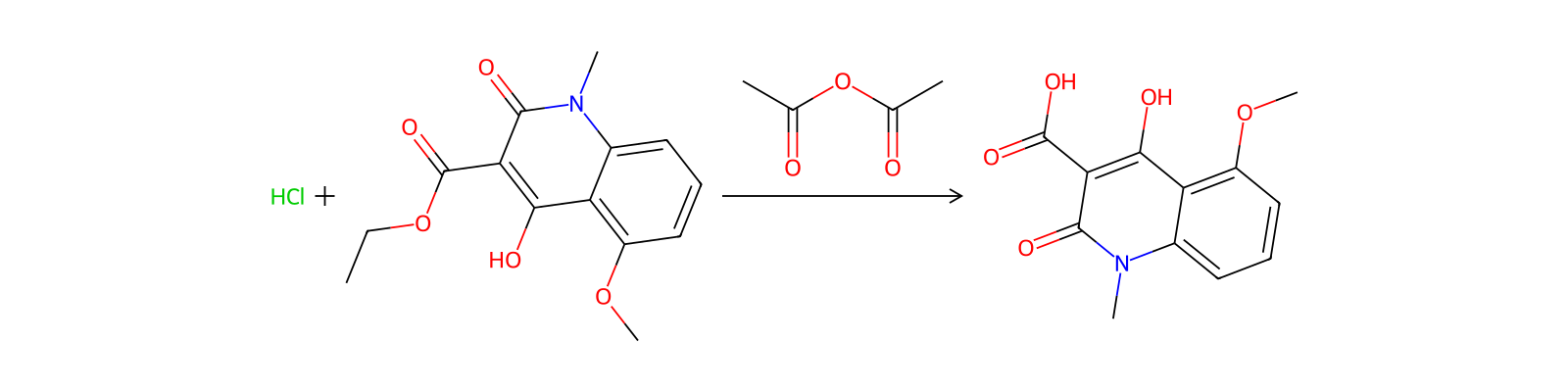
Cl.C([O:4][C:5]([C:7]1[C:8](=[O:21])[N:9]([CH3:20])[C:10]2[C:15]([C:16]=1[OH:17])=[C:14]([O:18][CH3:19])[CH:13]=[CH:12][CH:11]=2)=[O:6])C>C(OC(=O)C)(=O)C>[OH:17][C:16]1[C:15]2[C:10](=[CH:11][CH:12]=[CH:13][C:14]=2[O:18][CH3:19])[N:9]([CH3:20])[C:8](=[O:21])[C:7]=1[C:5]([OH:6])=[O:4]Participants
4




Conditions
- Temperature
- 80 °C
Procedure
While cooling, 10 ml of conc. hydrochloric acid was added to 30 ml of acetic anhydride. To this solution, 1,2-dihydro-4-hydroxy-5-methoxy-1-methyl-2-oxo-quinoline-3-carboxylic acid ethyl ester (10.5 g, 38 mmol) was added and the mixture heated at 80° C. for 14 hours. The mixture was cooled to room temperature and the crystalline product was filtered off, washed with cold methanol and dried to yield the title compound (7.2 g), yield 77%.
Workup
- temperatureWhile cooling
- temperatureThe mixture was cooled to room temperature
- filtrationthe crystalline product was filtered off
- washwashed with cold methanol
- customdried
Sources & evidence
- ORD record
- ord-ccbdc297d34a4db6a2c2c55bd05fabd1
- Source dataset
- uspto-grants-2000_10
- Patent number
- US06133285
Reaction notes
Loading…