Dichlorodimethylsilane → (Tetramethylcyclopentadienyl)dimethylchlorosilane
Reaction equation
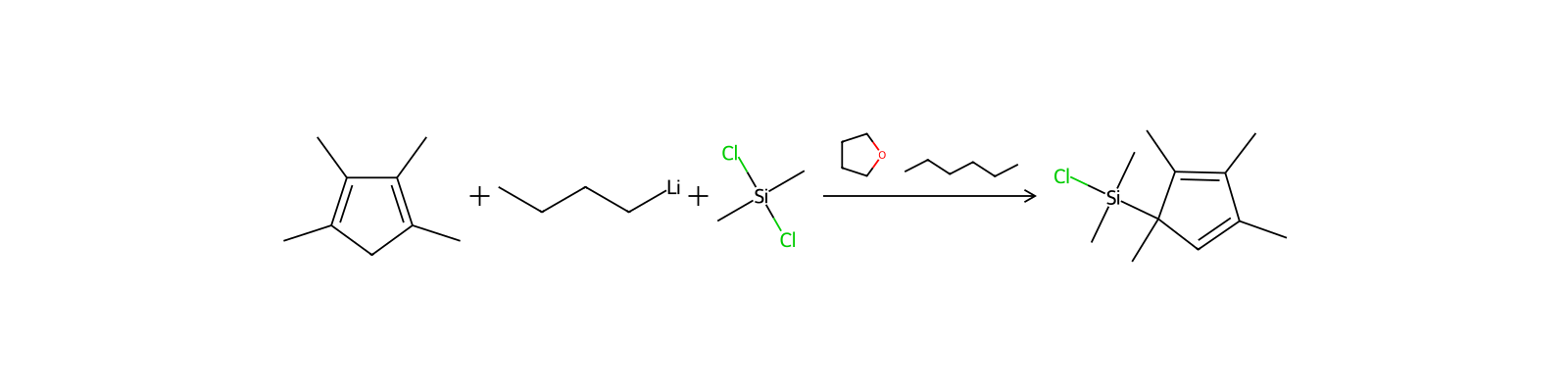
[CH3:1][C:2]1[CH2:6][C:5]([CH3:7])=[C:4]([CH3:8])[C:3]=1[CH3:9].C([Li])CCC.[Cl:15][Si:16](Cl)([CH3:18])[CH3:17]>O1CCCC1.CCCCCC>[CH3:1][C:2]1[C:3]([CH3:9])=[C:4]([CH3:8])[C:5]([Si:16]([CH3:18])([CH3:17])[Cl:15])([CH3:7])[CH:6]=1Participants
6






Conditions
- Temperature
- 0 °C
Procedure
Into a two-necked round-bottomed flask, the atmosphere in which was replaced with nitrogen, were charged 15 g of tetrahydrofuran, 12 g of n-hexane and 1.10 g of tetramethylcyclopentadiene. The mixture was cooled to 0° C. with stirring and 4.90 ml of n-butyl lithium (1.6M solution in n-hexane) (7.84 mmol as n-butyl lithium) was gradually added dropwise thereto over 20 minutes. The obtained reaction mixture in the form of a white slurry was stirred for at 0° C. for 3 hours, and a pre-cooled tetrahydrofuran (10 g) solution containing 1.01 g (7.84 mmol) of dichlorodimethylsilane was added in several divided portions. The mixture was then gradually heated to room temperature.
Workup
- customInto a two-necked round-bottomed flask, the atmosphere in which was replaced with nitrogen
- customThe obtained reaction mixture in the form of a white slurry
- stirringwas stirred for at 0° C. for 3 hours
- additionwas added
- temperatureThe mixture was then gradually heated to room temperature
Sources & evidence
- ORD record
- ord-48c8ad8012994a118792fd5630c0fe94
- Source dataset
- uspto-grants-2000_10
- Patent number
- US06136995
Reaction notes
Loading…