1-Phenylpiperazine → HCID 131719006, compound
Reaction equation
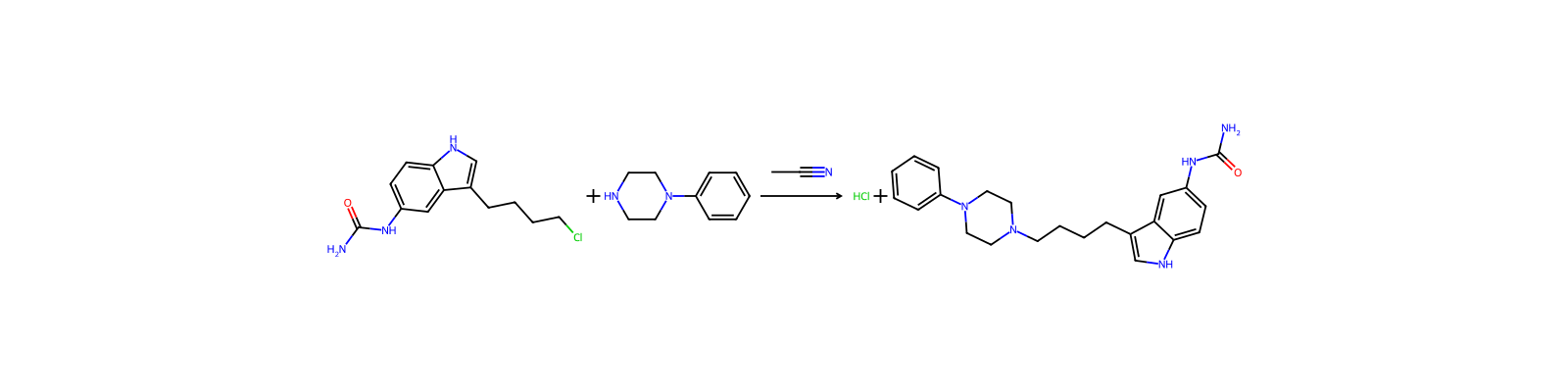
[Cl:1][CH2:2][CH2:3][CH2:4][CH2:5][C:6]1[C:14]2[C:9](=[CH:10][CH:11]=[C:12]([NH:15][C:16]([NH2:18])=[O:17])[CH:13]=2)[NH:8][CH:7]=1.[C:19]1([N:25]2[CH2:30][CH2:29][NH:28][CH2:27][CH2:26]2)[CH:24]=[CH:23][CH:22]=[CH:21][CH:20]=1>C(#N)C>[ClH:1].[C:19]1([N:25]2[CH2:30][CH2:29][N:28]([CH2:2][CH2:3][CH2:4][CH2:5][C:6]3[C:14]4[C:9](=[CH:10][CH:11]=[C:12]([NH:15][C:16]([NH2:18])=[O:17])[CH:13]=4)[NH:8][CH:7]=3)[CH2:27][CH2:26]2)[CH:24]=[CH:23][CH:22]=[CH:21][CH:20]=1Participants
4
Reactant 2


Product 1

Reagents, catalysts & solvents 1

Procedure
A solution of 2.6 g of 3-(4-chlorobutyl)-5-indolylurea [obtainable by reacting 5-nitroindole with 4-chlorobutyryl chloride to give 3-(4-chlorobutyryl)-5nitroindole, reduction with diborane to give 3-(4-chlorobutyl)-5-nitroindole hydrogenation to 3-(4-chlorobutyl)-5-aminoindole and reaction with KCNO] and 16.3 g of 1-phenylpiperazine in ("A") in 200 ml of acetonitrile is stirred for 12 hours at 20° and worked up in a conventional manner to give 3-[4-(4-phenylpiperazino)butyl]-5-indolylurea, hydrochloride, m.p. 207° (dec.).
Sources & evidence
- ORD record
- ord-964170a8707043ce97316fe0269f0520
- Source dataset
- uspto-grants-1995_05
- Patent number
- US05418237
Reaction notes
Loading…