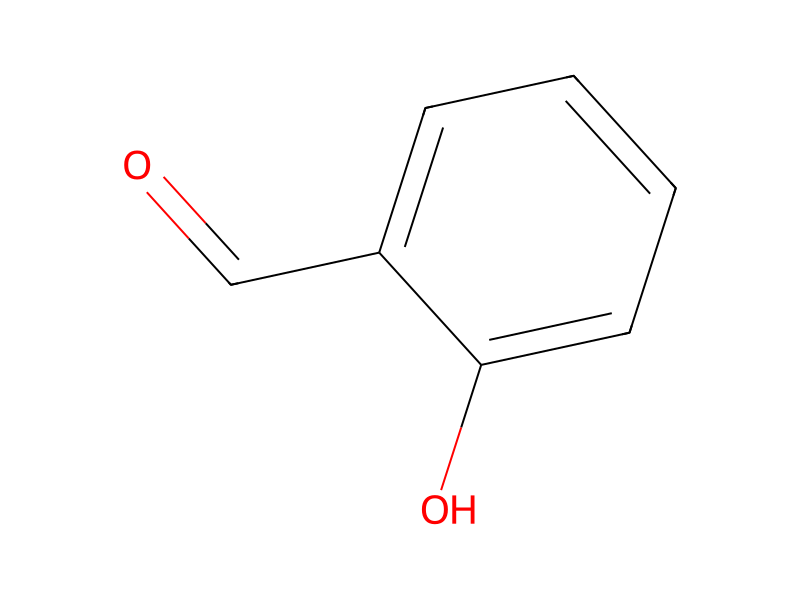
Salicylaldehyde → HCID 14367363, compound
Reaction equation

[OH-:1].[Na+].[OH:3][C:4]1[CH:11]=[CH:10][CH:9]=[CH:8][C:5]=1[CH:6]=[O:7]>C(O)(=O)C>[OH:3][C:4]1[CH:11]=[CH:10][CH:9]=[CH:8][C:5]=1[CH:6]([OH:7])[CH:6]([C:5]1[CH:8]=[CH:9][CH:10]=[CH:11][C:4]=1[OH:3])[OH:1]Participants
Reactant 2

Product 1

Reagents, catalysts & solvents 1

Procedure
The electrolytic cell was charged with 100 milliliters of 1.5 molar aqueous sodium hydroxide and 10.0 grams (0.082 mole) of 2-hydroxybenzaldehyde (salicylaldehyde). The electrolysis was conducted at a constant current of 3.0 amperes and a temperature of 28° C to 32° C over a 1-hour period. The cathode potential was -1.67 volts versus the saturated calomel electrode. Upon completion of the electrolysis, the solution was acidified to about 6.3 by the addition of glacial acetic acid and extracted with three 100-milliliter portions of ethyl acetate. The ethyl acetate extracts were combined, washed with three 100-milliliter portions of water, and dried over anhydrous magnesium sulfate. Evaporation of the solvent in vacuo and drying of the resulting oil material in a vacuum dessicator yielded 9.3 grams (46.0 percent) of 1,2-bis(2-hydroxyphenyl)-ethane-1,2-diol (2,2'-dihydroxyhydrobenzoin) as a mixture of oil and crystals. The identity of the material was confirmed by nuclear magnetic resonance spectroscopy in pyridine-d5.
Workup
- waita temperature of 28° C to 32° C over a 1-hour period
- extractionextracted with three 100-milliliter portions of ethyl acetate
- washwashed with three 100-milliliter portions of water
- dry with materialdried over anhydrous magnesium sulfate
- customEvaporation of the solvent in vacuo
- customdrying of the resulting oil material in a vacuum dessicator
Sources & evidence
- ORD record
- ord-2ab1b4be87ce430886330b16b57a5cda
- Source dataset
- uspto-grants-1978_05
- Patent number
- US04087336
Reaction notes
Loading…