Hydrochloric Acid → 6-Amino-2-(trifluoromethyl)-1H-imidazo[4,5-b]pyridin-1-ol
Reaction equation
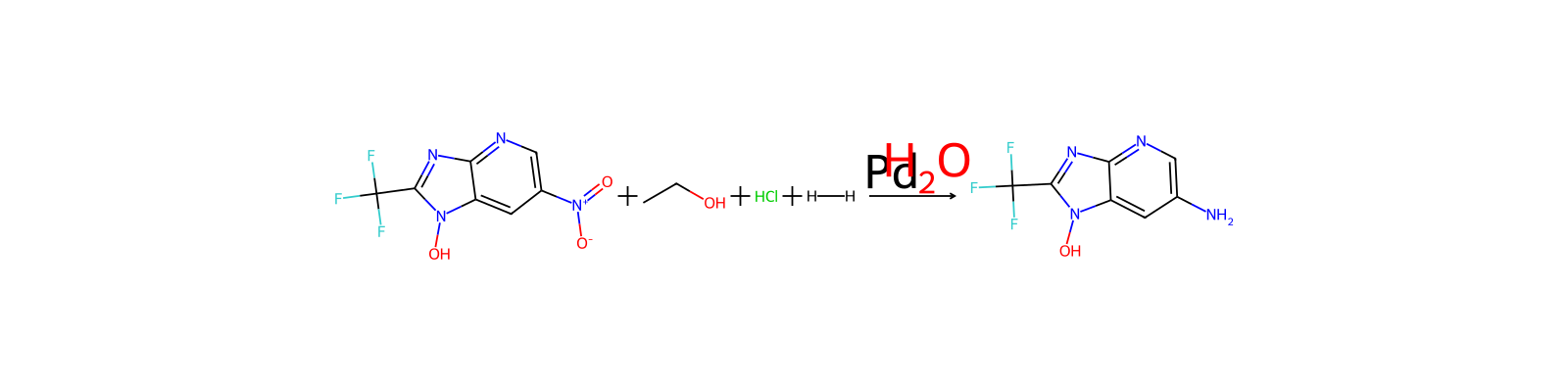
[N+:1]([C:4]1[CH:5]=[C:6]2[N:12]([OH:13])[C:11]([C:14]([F:17])([F:16])[F:15])=[N:10][C:7]2=[N:8][CH:9]=1)([O-])=O.C(O)C.Cl.[H][H]>[Pd].O>[NH2:1][C:4]1[CH:5]=[C:6]2[N:12]([OH:13])[C:11]([C:14]([F:15])([F:17])[F:16])=[N:10][C:7]2=[N:8][CH:9]=1Participants
7
Reactant 4




Product 1

Reagents, catalysts & solvents 2


Procedure
6-Nitro-1-hydroxy-2-(trifluoromethyl)-1H-imidazo(4,5-b)pyridine (4.9 grams) was mixed with 100 milliliters of ethanol and 3 milliliters of concentrated hydrochloric acid, and 1 gram of 5 percent palladium on carbon was added to the mixture. The mixture was hydrogenated to a 3 mole-equivalent uptake of hydrogen. The reaction mixture was then filtered and evaporated, yielding a gummy solid residue which was taken up in 150 milliliters of water and used directly in the reaction reported in the following example.
Workup
- additionwas added to the mixture
- filtrationThe reaction mixture was then filtered
- customevaporated
- customyielding a gummy solid residue which
Sources & evidence
- ORD record
- ord-9ee81935c37245bd9899f682e25f1938
- Source dataset
- uspto-grants-1978_05
- Patent number
- US04087432
Reaction notes
Loading…