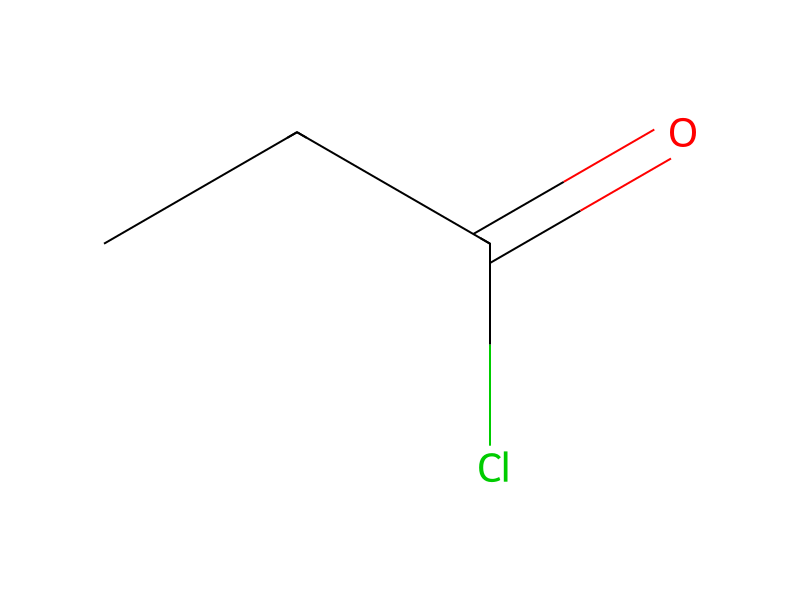
Propionyl chloride → HCID 131717641, compound
Reaction equation

[C:1]1([N:7]2[C:14](=[O:15])[CH:13]([CH2:16][CH:17]=[CH:18][CH3:19])[C:11](=[O:12])[NH:10][C:8]2=[O:9])[CH:6]=[CH:5][CH:4]=[CH:3][CH:2]=1.[C:20](Cl)(=[O:23])[CH2:21][CH3:22]>N1C=CC=CC=1>[C:1]1([N:7]2[C:14](=[O:15])[C:13]([CH2:16][CH:17]=[CH:18][CH3:19])([C:20](=[O:23])[CH2:21][CH3:22])[C:11](=[O:12])[NH:10][C:8]2=[O:9])[CH:2]=[CH:3][CH:4]=[CH:5][CH:6]=1Participants
Reactant 2

Product 1

Reagents, catalysts & solvents 1

Conditions
- Temperature
- 0 °C
Procedure
A quantity of 1.29 g of 1-phenyl-3-methylallyl-barbituric acid prepared as described in Example Ia) is dissolved in 10 ml of pyridine. 0.52 ml of propionyl chloride is added dropwise to this solution which is cooled at 0° C. The reaction mixture is stirred at approximately 0° C. for 30 minutes and then at room temperature for 3 hours, and is then poured on 50 ml of ice water. After stirring with active carbon and filtering, the filtrate is acidified with conc. hydrochloric acid and extracted with methylene chloride. The organic layer is separated, washed with water, dried and evaporated. The final product is purified by means of column chromatography: silica gel/methylene chloride. The title compound is obtained in a yield of 0.65 g; melting-point 76°-80° C.
Workup
- waitat room temperature for 3 hours
- stirringAfter stirring with active carbon
- filtrationfiltering
- extractionextracted with methylene chloride
- customThe organic layer is separated
- washwashed with water
- customdried
- customevaporated
- customThe final product is purified by means of column chromatography
Sources & evidence
- ORD record
- ord-17bf1731d3ea426cb2d90a3733bf67e6
- Source dataset
- uspto-grants-1992_11
- Patent number
- US05164396
Reaction notes
Loading…