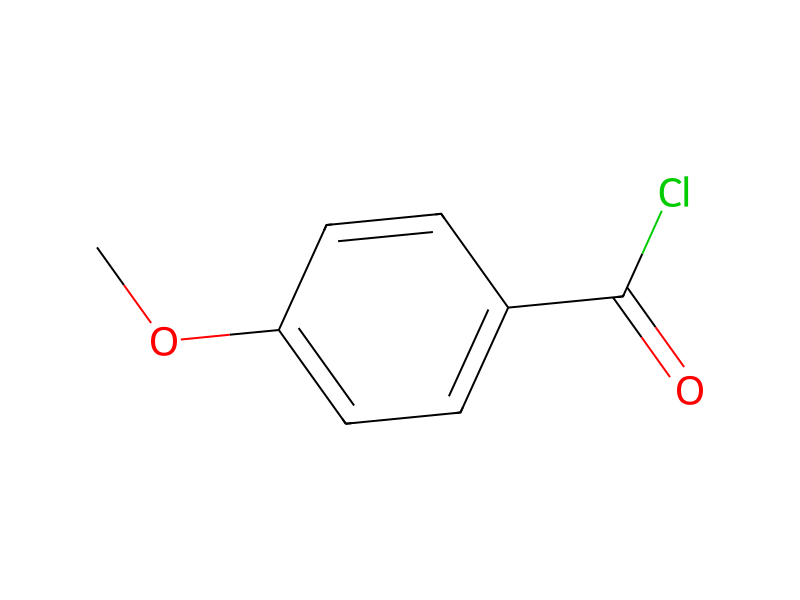
p-Anisoyl chloride → HCID 15288968, compound
Reaction equation

[F:1][C:2]([F:11])([F:10])[C:3]1([CH3:9])[NH:7][C:6](=[O:8])[CH2:5][CH2:4]1.C(N(CC)CC)C.[C:19](Cl)(=[O:28])[C:20]1[CH:25]=[CH:24][C:23]([O:26][CH3:27])=[CH:22][CH:21]=1>O1CCOCC1>[CH3:27][O:26][C:23]1[CH:24]=[CH:25][C:20]([C:19]([N:7]2[C:3]([C:2]([F:1])([F:10])[F:11])([CH3:9])[CH2:4][CH2:5][C:6]2=[O:8])=[O:28])=[CH:21][CH:22]=1Participants
5
Reactant 3


Product 1

Reagents, catalysts & solvents 1

Procedure
5.0 g (0.03 mol) of 5-(trifluoromethyl)-5-methylpyrrolidin-2-one in 10 ml of dioxane are stirred with 3.3 g of triethylamine and 6.8 g (0.04 mol) of anisoyl chloride for 16 h at 110°-120° C. The solid which precipitates is filtered off with suction and the salt is washed with a little dioxane. The dioxane solution is stirred into 50 ml of water and the organic phase is separated off with the addition of a little methylene chloride. After stripping off the solvent, the residue is a brownish solid which is recrystallized from ligroin.
Workup
- customThe solid which precipitates
- filtrationis filtered off with suction
- washthe salt is washed with a little dioxane
- customthe organic phase is separated off with the addition of a little methylene chloride
- customis recrystallized from ligroin
Sources & evidence
- ORD record
- ord-dfff1a4aacc547a5862497ce58d60b50
- Source dataset
- uspto-grants-1995_05
- Patent number
- US05420293
Reaction notes
Loading…