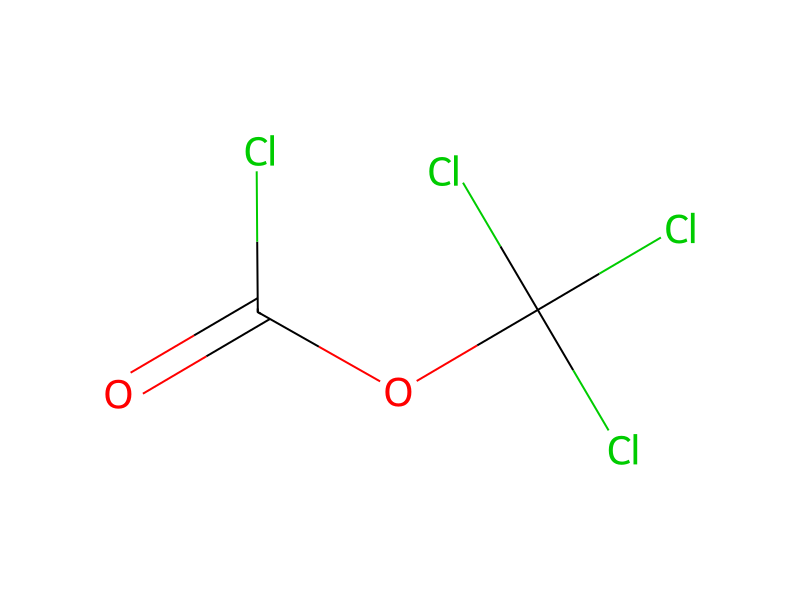
Diphosgene → 5-Isocyanato-2-(2,2,2-trifluoroethyl)-2-trifluoromethyl-1,3-benzodioxole
Reaction equation

[NH2:1][C:2]1[CH:19]=[CH:18][C:5]2[O:6][C:7]([CH2:13][C:14]([F:17])([F:16])[F:15])([C:9]([F:12])([F:11])[F:10])[O:8][C:4]=2[CH:3]=1.[O:20]=[C:21](Cl)OC(Cl)(Cl)Cl>O1CCOCC1>[N:1]([C:2]1[CH:19]=[CH:18][C:5]2[O:6][C:7]([CH2:13][C:14]([F:17])([F:16])[F:15])([C:9]([F:10])([F:11])[F:12])[O:8][C:4]=2[CH:3]=1)=[C:21]=[O:20]Participants
4



Conditions
- Temperature
- 110 °C
Procedure
37 g of the product of Example 33 were dissolved in 50 ml of absolute 1,4-dioxane, and a solution of 13.5 g of diphosgene in 80 ml of absolute 1,4-dioxane was added. The mixture was then stirred for 6 hours at 110° C. (bath temperature), the solvent was then removed under vacuum and the remaining residue was subjected to fractional distillation under vacuum to give 18 g of product (=44% of theory) with a boiling point of 63° C. at 0.1 mbar. NMR: -59.3 and -85.0 ppm. 1H NMR: 3.0 ppm.
Workup
- customthe solvent was then removed under vacuum
- distillationthe remaining residue was subjected to fractional distillation under vacuum
Sources & evidence
- ORD record
- ord-736b9ea5027648c8a3746f1d33760ede
- Source dataset
- uspto-grants-1995_05
- Patent number
- US05420309
Reaction notes
Loading…