1-Bromo-3,5-difluorobenzene → methyl 8-(1-(3,5-difluorophenyl)pyrrolidin-2-yl)-2-morpholino-4-oxo-4H-chromene-6-carboxylate
Reaction equation

COC(=O)c1cc(C2CCCN2)c2oc(N3CCOCC3)cc(=O)c2c1.Fc1cc(F)cc(Br)c1>C1COCCO1.CC1(C)c2cccc(P(c3ccccc3)c3ccccc3)c2Oc2c(P(c3ccccc3)c3ccccc3)cccc21.CC1(C)c2cccc([PH+](c3ccccc3)c3ccccc3)c2Oc2c([PH+](c3ccccc3)c3ccccc3)cccc21.Fc1c[c-]cc(F)c1.O=C([O-])[O-].[Br][Pd+].[Cs+].[Cs+]>COC(=O)c1cc(C2CCCN2c2cc(F)cc(F)c2)c2oc(N3CCOCC3)cc(=O)c2c1Participants
Reactant 2

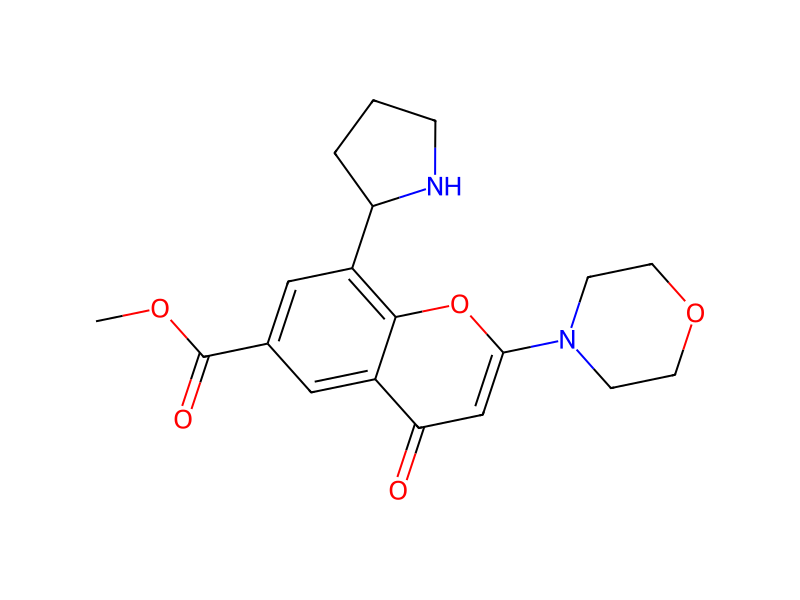
Product 1

Reagents, catalysts & solvents 4




Conditions
- Temperature
- 100 °C
Procedure
Pd complexe (142 mg, 0.16 mmol) was added to a stirred mixture of methyl 2-morpholino-4-oxo-8-(pyrrolidin-2-yl)-4H-chromene-6-carboxylate (577 mg, 1.61 mmol), 1-bromo-3,5-difluorobenzene (0.232 ml, 2.01 mmol) and cesium carbonate (787 mg, 2.41 mmol) dissolved in 1,4-dioxane (12 ml). The resulting suspension was degased with argon and then stirred at 100 °C (10:30). After 3 hours, lcms showed complete reaction. The reaction mixture was allowed to cool to room temperature, filtered and concentrated. The crude product was purified by flash chromatography on silica gel eluting with 0 to 6% methanol in ethyl acetate. The solvent was evaporated to dryness to afford methyl 8-(1-(3,5-difluorophenyl)pyrrolidin-2-yl)-2-morpholino-4-oxo-4H-chromene-6-carboxylate (315 mg, 41.6 %) as a clear yellow foam. **low yield but LCMS of the crude showed complete reaction!** LCMS and NMR are OK
Sources & evidence
- ORD record
- ord-a83a9a777a784ae7bc91d681e967fa73
- Source dataset
- 750 AstraZeneca ELN dataset
- Original link
- View source
Reaction notes
Loading…