Pyrrolidine → 1-[(5-Bromo-2-thienyl)methyl]pyrrolidine
Reaction equation

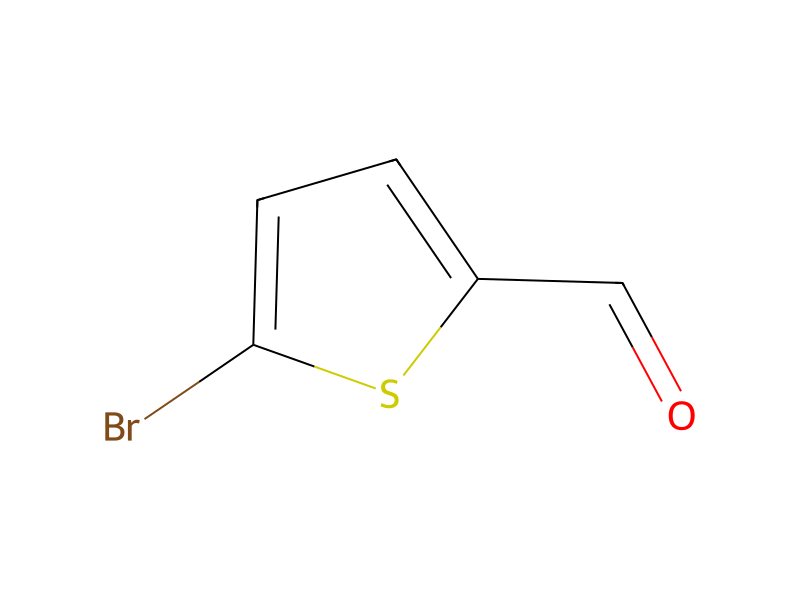
[Br:1][C:2]1[S:6][C:5]([CH:7]=O)=[CH:4][CH:3]=1.[NH:9]1[CH2:13][CH2:12][CH2:11][CH2:10]1.C(O[BH-](OC(=O)C)OC(=O)C)(=O)C.[Na+]>ClCCl.CN(C)C=O.C(O)(=O)C>[Br:1][C:2]1[S:6][C:5]([CH2:7][N:9]2[CH2:13][CH2:12][CH2:11][CH2:10]2)=[CH:4][CH:3]=1Participants
Reactant 3


Product 1

Reagents, catalysts & solvents 3



Conditions
- Temperature
- 0 °C
Procedure
5-Bromo-2-thiophenecarbaldehyde (191 mg, 1.0 mmol) was diluted in a mixture of dichloromethane (6 mL) and N,N-dimethylformamide (2 mL), and cooled to 0° C. Pyrrolidine (107 mg, 1.5 mmol)) was added, followed by sodium triacetoxyborohydride (1.04 g, 4.9 mmol, 4.9 eq) and glacial acetic acid (2 drops). The reaction mixture was stirred at 23° C. for 2 h, then carefully quenched with saturated aq sodium bicarbonate (fizzing!). The reaction mixture was extracted with dichloromethane (2×10 mL), then the combined organic layers were filtered through a SCX cartridge (5 grams), eluting with methanol (10 mL). The first fraction was discarded if no product was present by tlc, and the desired product was eluted from the resin with methanol in ammonia (2M, Aldrich, 25 mL). The latter fraction was concentrated to afford 349 mg (>100%) of the title compound.
Workup
- customcarefully quenched with saturated aq sodium bicarbonate (fizzing!)
- extractionThe reaction mixture was extracted with dichloromethane (2×10 mL)
- filtrationthe combined organic layers were filtered through a SCX cartridge (5 grams)
- washeluting with methanol (10 mL)
- washwas eluted from the resin with methanol in ammonia (2M, Aldrich, 25 mL)
- concentrationThe latter fraction was concentrated
Sources & evidence
- ORD record
- ord-84c7c26e65a6431ea878132c7bd34842
- Source dataset
- uspto-grants-2013_02
- Patent number
- US08372875B2
Reaction notes
Loading…