Diisopropylethylamine → (S)-tert-butyl 2-(4-chlorophenyl)-3-(4-(5-(3-fluorophenoxy)-1H-pyrazolo[3,4-b]pyridin-4-yl)piperazin-1-yl)-3-oxopropyl(isopropyl)carbamate
Reaction equation

CCN(C(C)C)C(C)C.Cl.Cl.[F:12][C:13]1[CH:14]=[C:15]([CH:32]=[CH:33][CH:34]=1)[O:16][C:17]1[C:18]([N:26]2[CH2:31][CH2:30][NH:29][CH2:28][CH2:27]2)=[C:19]2[CH:25]=[N:24][NH:23][C:20]2=[N:21][CH:22]=1.F[B-](F)(F)F.N1(OC(N(C)C)=[N+](C)C)C2C=CC=CC=2N=N1.[C:57]([O:61][C:62]([N:64]([CH:77]([CH3:79])[CH3:78])[CH2:65][C@H:66]([C:70]1[CH:75]=[CH:74][C:73]([Cl:76])=[CH:72][CH:71]=1)[C:67](O)=[O:68])=[O:63])([CH3:60])([CH3:59])[CH3:58]>C(Cl)Cl>[Cl:76][C:73]1[CH:74]=[CH:75][C:70]([C@H:66]([C:67]([N:29]2[CH2:30][CH2:31][N:26]([C:18]3[C:17]([O:16][C:15]4[CH:32]=[CH:33][CH:34]=[C:13]([F:12])[CH:14]=4)=[CH:22][N:21]=[C:20]4[NH:23][N:24]=[CH:25][C:19]=34)[CH2:27][CH2:28]2)=[O:68])[CH2:65][N:64]([CH:77]([CH3:78])[CH3:79])[C:62](=[O:63])[O:61][C:57]([CH3:59])([CH3:58])[CH3:60])=[CH:71][CH:72]=1Participants
Reactant 4



Product 1

Reagents, catalysts & solvents 1

Procedure
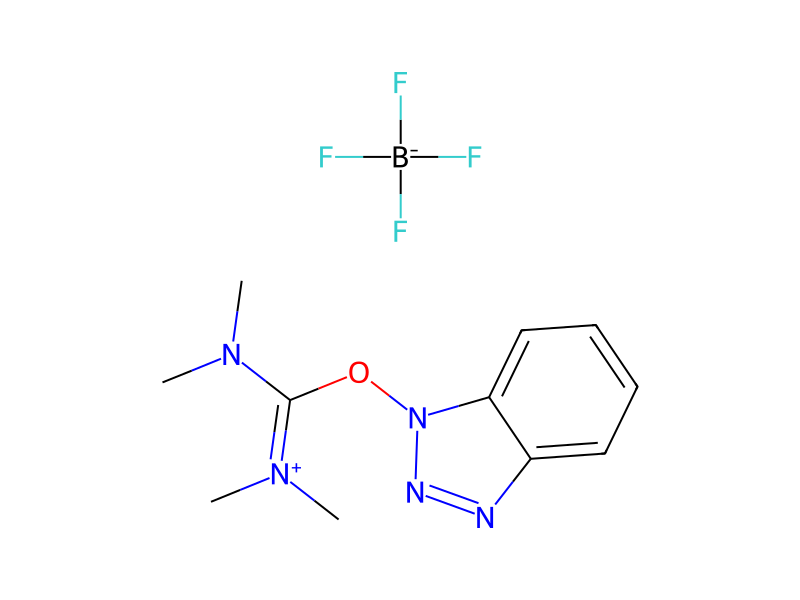
DIEA (0.0271 mL, 0.155 mmol) was added to 5-(3-fluorophenoxy)-4-(piperazin-1-yl)-1H-pyrazolo[3,4-b]pyridine dihydrochloride (0.015 g, 0.0388 mmol), 2-(1H-benzo[d][1,2,3]triazol-1-yl)-1,1,3,3-tetramethyluronium tetrafluoroborate (0.0150 g, 0.0466 mmol) and (S)-3-(tert-butoxycarbonyl(isopropyl)amino)-2-(4-chlorophenyl)propanoic acid (0.0133 g, 0.0388 mmol, see Example B) in DCM (1 mL) and stirred at room temperature for 30 minutes. The reaction was then concentrated to dryness. The resulting residue was dissolved in THF/MeOH (2 mL, 1:1), and an aqueous LiOH solution (1 mL, 2M) was added. The reaction was stirred for 30 minutes, and then ether (20 mL) was added. The organic layer was separated, washed with brine (10 mL), and dried over sodium sulfate. After removal of the solvent, the resulting residue was purified by column chromatography (hexane:ethyl acetate, 1:1) to give (S)-tert-butyl 2-(4-chlorophenyl)-3-(4-(5-(3-fluorophenoxy)-1H-pyrazolo[3,4-b]pyridin-4-yl)piperazin-1-yl)-3-oxopropyl(isopropyl)carbamate as a solid. The solid was dissolved in DCM (1 mL), and TFA (0.4 mL) was added. The reaction was stirred at room temperature for 30 minutes and concentrated to dryness. The residue was dissolved in DCM (0.5 mL), and HCl in ether (1 mL, 2N) was added. The resulting solid was collected by filtration to give (S)-2-(4-chlorophenyl)-1-(4-(5-(3-fluorophenoxy)-1H-pyrazolo[3,4-b]pyridin-4-yl)piperazin-1-yl)-3-(isopropylamino)propan-1-one (0.006 g, 25%). MS APCI (+) m/z 537.3 detected.
Workup
- concentrationThe reaction was then concentrated to dryness
- dissolutionThe resulting residue was dissolved in THF/MeOH (2 mL, 1:1)
- additionan aqueous LiOH solution (1 mL, 2M) was added
- stirringThe reaction was stirred for 30 minutes
- additionether (20 mL) was added
- customThe organic layer was separated
- washwashed with brine (10 mL)
- dry with materialdried over sodium sulfate
- customAfter removal of the solvent
- customthe resulting residue was purified by column chromatography (hexane:ethyl acetate, 1:1)
Sources & evidence
- ORD record
- ord-c3b58f81f4694ece80193a8e74ec852f
- Source dataset
- uspto-grants-2013_02
- Patent number
- US08372842B2
Reaction notes
Loading…