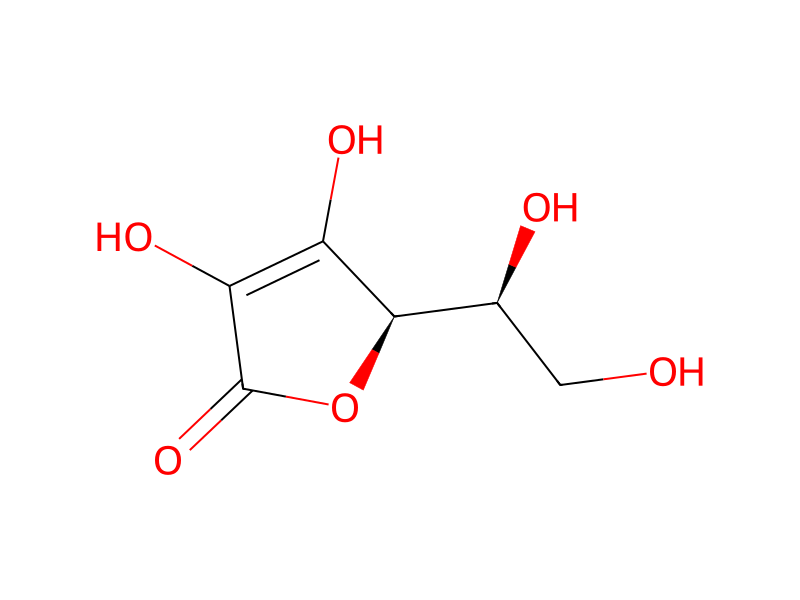
Acetone → 5-(2,2-dimethyl-1,3-dioxolan-4-yl)-3,4-dihydroxy-2(5H)-furanone
Reaction equation

C(Cl)(=O)C.[O:5]=[C:6]1[O:12][C@H:11]([C@H:13]([CH2:15][OH:16])[OH:14])[C:9]([OH:10])=[C:7]1[OH:8].[CH3:17][C:18]([CH3:20])=O>>[CH3:17][C:18]1([CH3:20])[O:14][CH:13]([CH:11]2[O:12][C:6](=[O:5])[C:7]([OH:8])=[C:9]2[OH:10])[CH2:15][O:16]1Participants
4



Conditions
- Temperature
- 32.5 °C
Procedure
5,6-O-isopropylidene-L-ascorbic acid was synthesized by the addition of acetyl chloride (124.9 mL) to a slurry of L-ascorbic acid USP (1000 g) in acetone (4.5 L). The mixture was stirred vigorously at 35-30° C. After two hours, the crystalline product separated. The crystals were collected by filtration, washed with cold acetone, and dried in a vacuum desciccator over potassium hydroxide pellets. The product, produced in 77% yield, consisted of needle-shaped crystals with a melting point of 217-223° C.
Workup
- customthe crystalline product separated
- filtrationThe crystals were collected by filtration
- washwashed with cold acetone
- dry with materialdried in a vacuum desciccator over potassium hydroxide pellets
- customThe product, produced in 77% yield
Sources & evidence
- ORD record
- ord-f001b44cc63c4991a0b339e264d0f5da
- Source dataset
- uspto-grants-2003_08
- Patent number
- US06602906B1
Reaction notes
Loading…