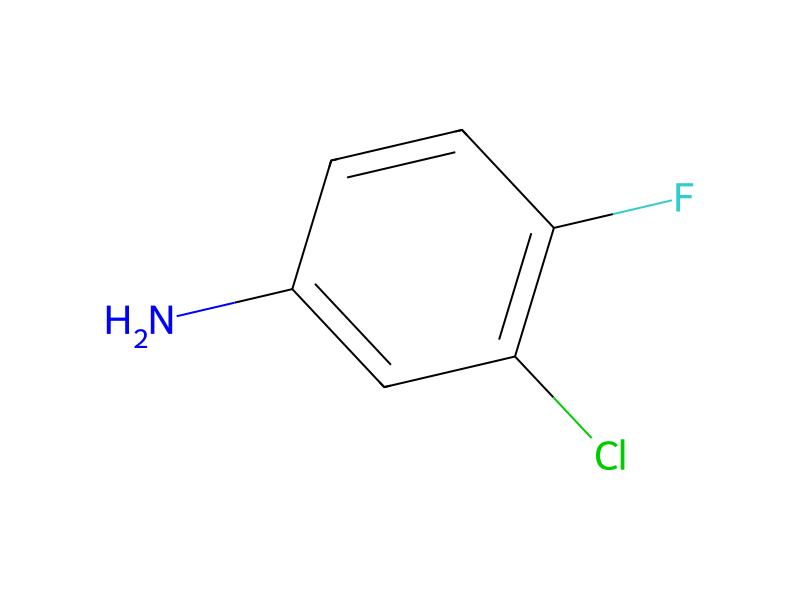
3-Chloro-4-fluoroaniline → 4-(3-Chloro-4-fluoro-phenylamino)-7-methoxy-6-nitro-quinoline-3-carbonitrile
Reaction equation

Cl[C:2]1[C:11]2[C:6](=[CH:7][C:8]([O:15][CH3:16])=[C:9]([N+:12]([O-:14])=[O:13])[CH:10]=2)[N:5]=[CH:4][C:3]=1[C:17]#[N:18].[Cl:19][C:20]1[CH:21]=[C:22]([NH2:27])[CH:23]=[CH:24][C:25]=1[F:26]>CC(O)C>[Cl:19][C:20]1[CH:21]=[C:22]([NH:27][C:2]2[C:11]3[C:6](=[CH:7][C:8]([O:15][CH3:16])=[C:9]([N+:12]([O-:14])=[O:13])[CH:10]=3)[N:5]=[CH:4][C:3]=2[C:17]#[N:18])[CH:23]=[CH:24][C:25]=1[F:26]Participants
4


Procedure
An amount of 4-chloro-7-methoxy-6-nitro-quinoline-3-carbonitrile (7.1 g, 26.9 mmol), and 3-chloro-4-fluoro-phenylamine (3.9 g, 26.8 mmol), were stirred in 2-propanol (70 mL), and heated at reflux for 2 hours. The mixture was cooled to room temperature and stirred for an additional 20 hours. The reaction mixture was evaporated to dryness, stirred with ethyl acetate and saturated sodium bicarbonate solution. After separation of the layers, the organic layer was washed with saturated brine solution and dried on magnesium sulfate, to give a dark green powder (9.9 g, 99%), which was used without further purification.
Workup
- temperatureheated
- temperatureat reflux for 2 hours
- customThe reaction mixture was evaporated to dryness
- stirringstirred with ethyl acetate and saturated sodium bicarbonate solution
- customAfter separation of the layers
- washthe organic layer was washed with saturated brine solution
- customdried on magnesium sulfate
Sources & evidence
- ORD record
- ord-02b0de6ba631466580d08addf87b88f4
- Source dataset
- uspto-grants-2003_08
- Patent number
- US06608048B2
Reaction notes
Loading…