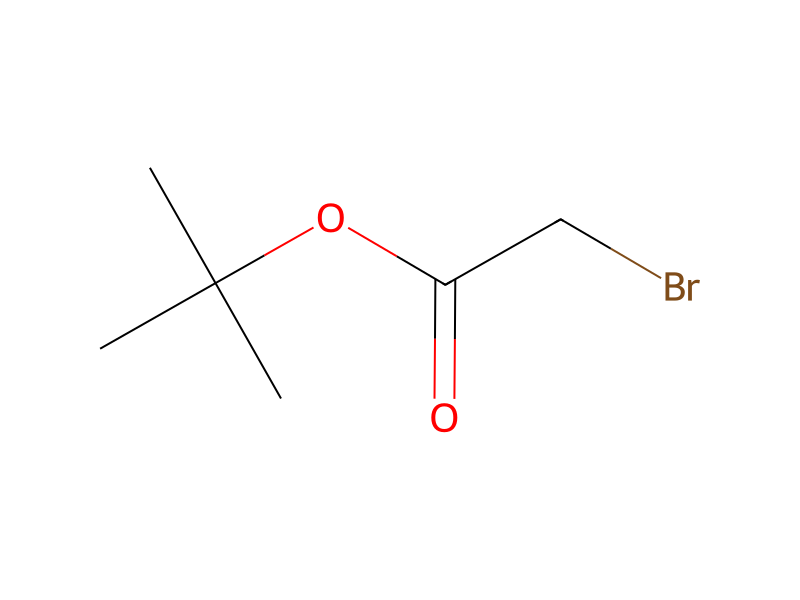
tert-Butyl bromoacetate → tert-Butyl 3-nitro-2-oxo-1(2H)-pyridineacetate
Reaction equation

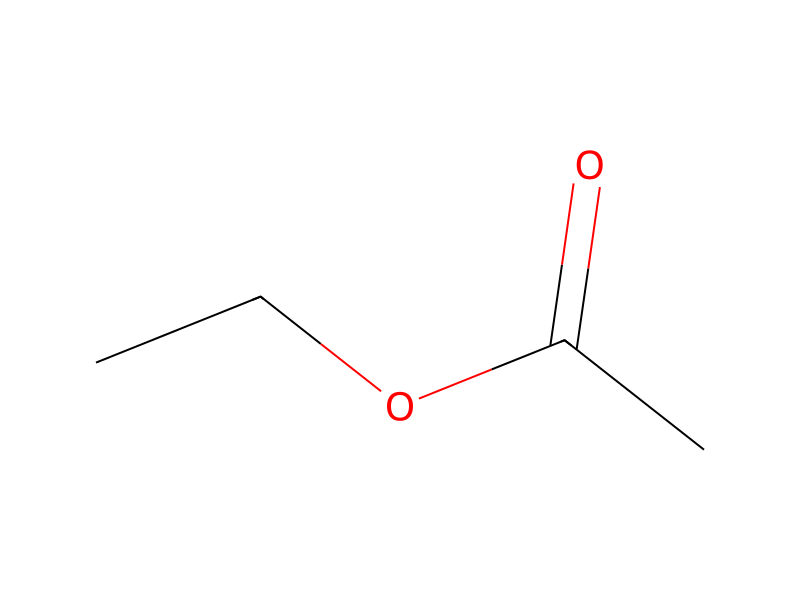
[N+:1]([C:4]1[C:5]([OH:10])=[N:6][CH:7]=[CH:8][CH:9]=1)([O-:3])=[O:2].Br[CH2:12][C:13]([O:15][C:16]([CH3:19])([CH3:18])[CH3:17])=[O:14]>C(OCC)(=O)C>[N+:1]([C:4]1[C:5](=[O:10])[N:6]([CH2:12][C:13]([O:15][C:16]([CH3:19])([CH3:18])[CH3:17])=[O:14])[CH:7]=[CH:8][CH:9]=1)([O-:3])=[O:2]Participants
Reactant 2

Product 1

Reagents, catalysts & solvents 1
Conditions
- Temperature
- 0 °C
Procedure
Sodium hydride (1.57 g of a 60% dispersion in mineral oil, 0.039 mole) was washed with hexanes three times (10 mL each) and suspended in dimethylformamide (25 mL). The stirred suspension was cooled in an ice bath, then 3-nitro-2-hydroxypyridine (5.00 g, 0.036 mole) was added in small portions over a 25-minute period. After the addition was complete, the reaction was stirred at 0° C. for 10 minutes, then room temperature for 30 minutes. The reaction mixture was recooled in an ice bath, t-Butyl bromoacetate (5.25 mL, 0.036 mole) was added. The reaction was stirred at 0° C. for 1 hour, then 1.5 hours at room temperature. The reaction mixture was diluted with ethyl acetate (80 mL), and ice (80 g) was added. The aqueous layer was extracted with ethyl acetate (3×200 mL). The combined organic extracts were washed with water (4×100 mL), brine (100 mL), and dried over anhydrous sodium sulfate. The solvent was removed, and the resulting residue was chromatographed through silica gel using 10% ethyl acetate/dichloromethane as eluent. The pure fractions were combined, and the solvent was removed under vacuum to afford 6.77 g (75% yield) of the title compound as yellow solid. Rf=0.30 (silica gel, 20% ethyl acetate in dichloromethane).
Workup
- washSodium hydride (1.57 g of a 60% dispersion in mineral oil, 0.039 mole) was washed with hexanes three times (10 mL each)
- temperatureThe stirred suspension was cooled in an ice bath
- additionAfter the addition
- waitroom temperature for 30 minutes
- customThe reaction mixture was recooled in an ice bath
- stirringThe reaction was stirred at 0° C. for 1 hour
- custom1.5 hours
- customat room temperature
- additionwas added
- extractionThe aqueous layer was extracted with ethyl acetate (3×200 mL)
- washThe combined organic extracts were washed with water (4×100 mL), brine (100 mL)
- dry with materialdried over anhydrous sodium sulfate
- customThe solvent was removed
- customthe resulting residue was chromatographed through silica gel using 10% ethyl acetate/dichloromethane as eluent
- customthe solvent was removed under vacuum
Sources & evidence
- ORD record
- ord-482cd944a6ed42e89ba757aa00335075
- Source dataset
- uspto-grants-2003_08
- Patent number
- US06608204B1
Reaction notes
Loading…