Diisopropylethylamine → HCID 59708434, compound
Reaction equation

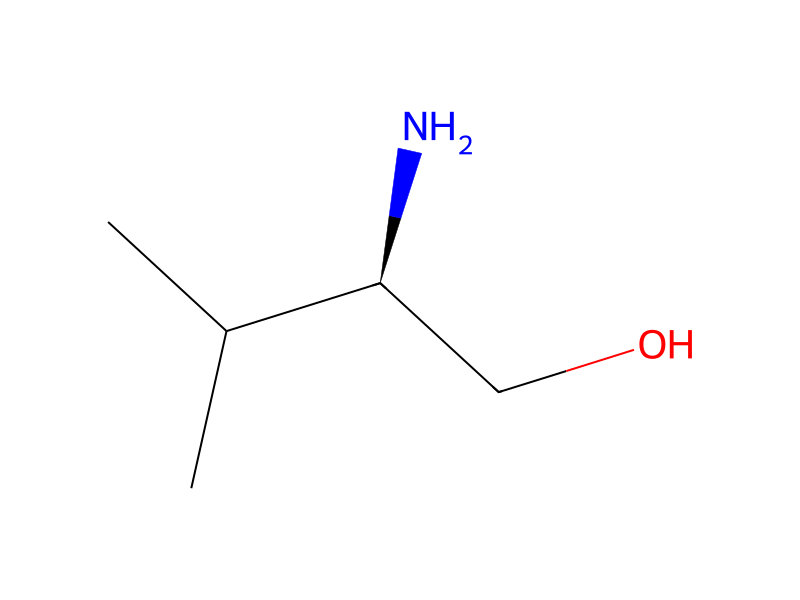
[Cl:1][C:2]1[N:3]=[C:4](Cl)[C:5]2[S:10][CH2:9][CH2:8][C:6]=2[N:7]=1.C(N(C(C)C)CC)(C)C.[NH2:21][C@H:22]([CH:25]([CH3:27])[CH3:26])[CH2:23][OH:24]>O1CCOCC1>[Cl:1][C:2]1[N:3]=[C:4]([NH:21][C@H:22]([CH:25]([CH3:27])[CH3:26])[CH2:23][OH:24])[C:5]2[S:10][CH2:9][CH2:8][C:6]=2[N:7]=1Participants
5
Reactant 3


Product 1

Reagents, catalysts & solvents 1

Conditions
- Temperature
- 100 °C
Procedure
7.2 g of 2,4-dichloro-6,7-dihydrothieno[3,2-d]pyrimidin (II) are in 36 ml dioxane placed, and then first 18 ml diisopropylethylamine, then 6.1 g (R)-(−)-2-amino-3-methyl-1-butanol are added. The reaction mixture is heated to 100° C., until there is no further reaction and cooled, then evaporated down. The residue is treated with petroleum ether/ethyl acetate (9:1) in the ultrasound bath and the solid is suction filtered and dried. 8.3 g (III-1) are obtained as a solid. Analytical HPLC (method A): RT=2.75 min
Workup
- customno further reaction
- temperaturecooled
- customevaporated down
- additionThe residue is treated with petroleum ether/ethyl acetate (9:1) in the ultrasound bath
- filtrationfiltered
- customdried
- custom8.3 g (III-1) are obtained as a solid
Sources & evidence
- ORD record
- ord-0cdd30ebb1f94ec2b3020b3514a1e0bd
- Source dataset
- uspto-grants-2014_06
- Patent number
- US08754073B2
Reaction notes
Loading…