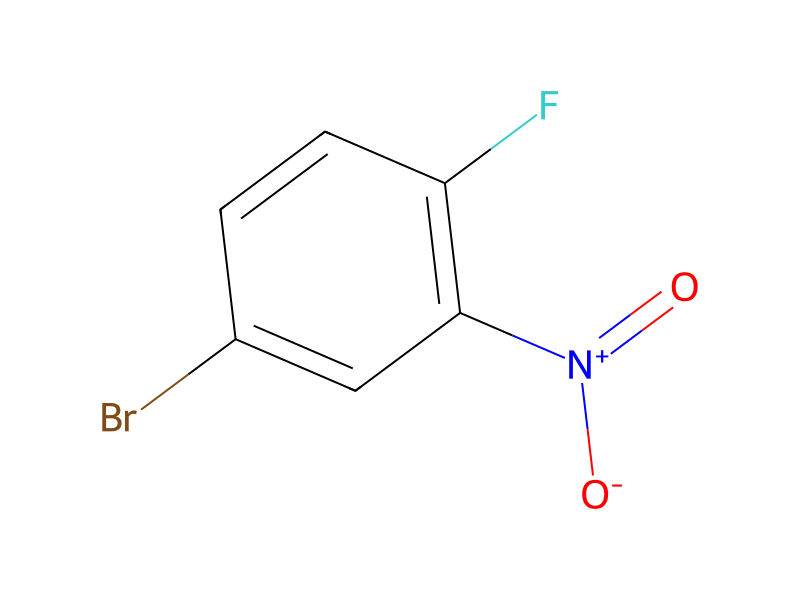
4-Bromo-1-fluoro-2-nitrobenzene → HCID 68054129, compound
Reaction equation

[Br:1][C:2]1[CH:7]=[CH:6][C:5](F)=[C:4]([N+:9]([O-:11])=[O:10])[CH:3]=1.[NH2:12][C:13]1[CH:14]=[C:15]([NH:19][C:20](=[O:26])[O:21][C:22]([CH3:25])([CH3:24])[CH3:23])[CH:16]=[CH:17][CH:18]=1>CN1CCCC1=O>[Br:1][C:2]1[CH:7]=[CH:6][C:5]([NH:12][C:13]2[CH:14]=[C:15]([NH:19][C:20](=[O:26])[O:21][C:22]([CH3:24])([CH3:23])[CH3:25])[CH:16]=[CH:17][CH:18]=2)=[C:4]([N+:9]([O-:11])=[O:10])[CH:3]=1Participants
4
Reactant 2

Product 1

Reagents, catalysts & solvents 1

Procedure
A mixture of 4-bromo-1-fluoro-2-nitrobenzene (6.0 g, 27 mmol, Aldrich, Cat. No. 539112) and tert-butyl (3-aminophenyl)carbamate (6.7 g, 32 mmol, Aldrich, Cat. No. 53175) in N-methylpyrrolidinone (30 mL) was heated at 150° C. overnight. The solution was cooled to room temperature (r.t.) and quenched with NaHCO3 aqueous solution, then extracted with ethyl acetate twice. The combined organic phases were washed with brine, and dried over MgSO4. After filtration, the filtrate was concentrated under reduced pressure to afford the desired compound (10.1 g, 91%). LCMS (M+H)+: m/z=408.0.
Workup
- customquenched with NaHCO3 aqueous solution
- extractionextracted with ethyl acetate twice
- washThe combined organic phases were washed with brine
- dry with materialdried over MgSO4
- filtrationAfter filtration
- concentrationthe filtrate was concentrated under reduced pressure
Sources & evidence
- ORD record
- ord-f30dd574f47846eaa8a020224085ba67
- Source dataset
- uspto-grants-2014_06
- Patent number
- US08754114B2
Reaction notes
Loading…