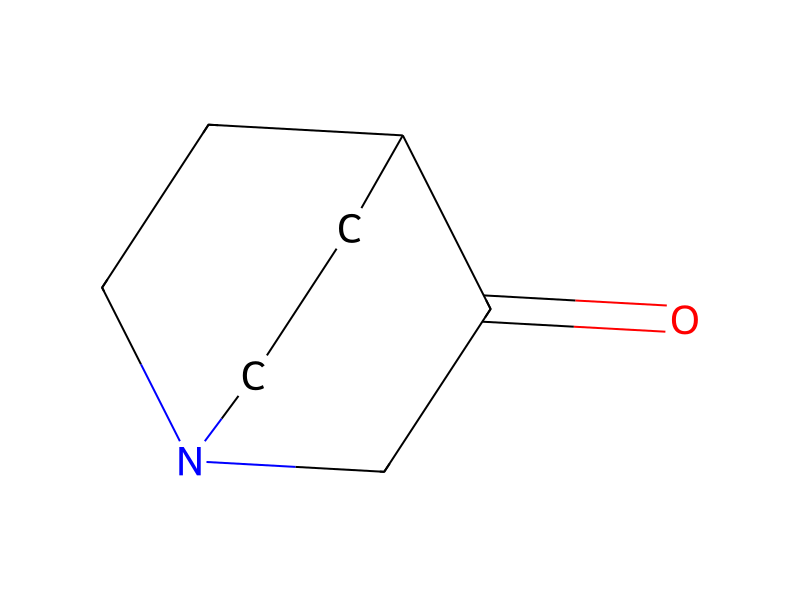
3-Quinuclidinone → 3-Quinuclidinol, (-)-
Reaction equation

[N:1]12[CH2:8][CH2:7][CH:4]([CH2:5][CH2:6]1)[C:3](=[O:9])[CH2:2]2.CC(C)([O-])C.[K+].[H][H]>CC(O)C>[N:1]12[CH2:8][CH2:7][CH:4]([CH2:5][CH2:6]1)[C@@H:3]([OH:9])[CH2:2]2Participants
Reactant 3


Product 1

Reagents, catalysts & solvents 1

Procedure
1.63 g (13 mmol) of the 3-quinuclidinone (I), 1.1 mg (1.3 μmol) of {[(S)-(6,6′-dimethyl-1,1′-biphenyl-2,2′-diyl)-bis(diphenylphosphine)]ruthenium (II) dichloride (DMF)n} complex, 12.7 ml of 2-propanol and 31 μl (1.55 μmol) of a 0.05 M 2-propanol solution of (2R,3R,4R,5R)-3,4-O-isopropylidenehexane-2,5-diamine were added to an autoclave in which the inside had been replaced with argon followed by carrying out a degassing procedure and stirring for 30 minutes at room temperature. 0.26 mL (0.26 mmol) of a 2-propanol solution of potassium tert-butoxide (1.0 M) were added thereto followed by stirring for 16 hours at 20 to 25° C. at a hydrogen pressure of 2.0 MPa to obtain (R)-3-quinuclidinol (3-R). S/C, conversion rate and enantiomeric excess are indicated below.
Sources & evidence
- ORD record
- ord-ba19e5fe18bc4cc0a9db2aa7baddadc1
- Source dataset
- uspto-grants-2014_06
- Patent number
- US08759524B2
Reaction notes
Loading…