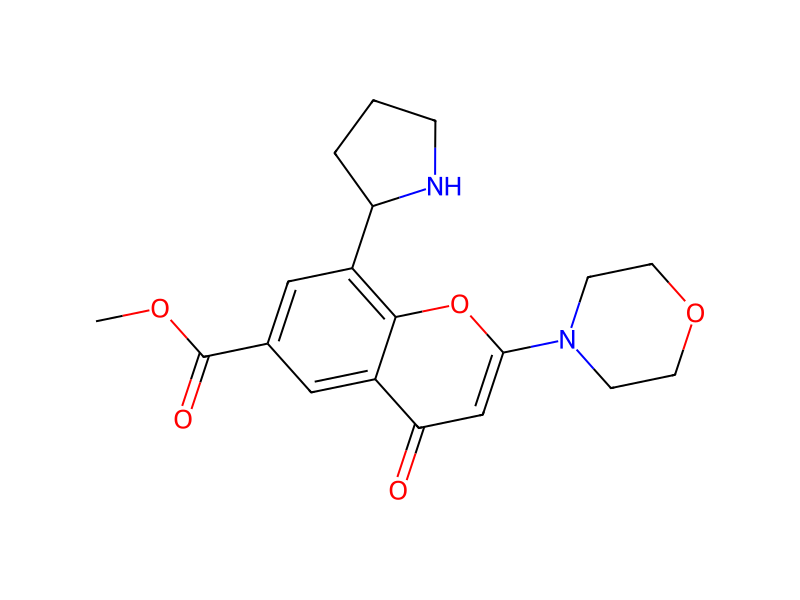
Hydrochloric Acid → methyl 2-morpholino-4-oxo-8-(pyrrolidin-2-yl)-4H-chromene-6-carboxylate
Reaction equation

Cl.[CH3:2][O:3][C:4]([C:6]1[CH:7]=[C:8]2[C:13](=[C:14]([CH:16]3[CH2:20][CH2:19][CH2:18][N:17]3C(OC(C)(C)C)=O)[CH:15]=1)[O:12][C:11]([N:28]1[CH2:33][CH2:32][O:31][CH2:30][CH2:29]1)=[CH:10][C:9]2=[O:34])=[O:5].C(Cl)Cl>O1CCOCC1>[O:31]1[CH2:30][CH2:29][N:28]([C:11]2[O:12][C:13]3[C:8]([C:9](=[O:34])[CH:10]=2)=[CH:7][C:6]([C:4]([O:3][CH3:2])=[O:5])=[CH:15][C:14]=3[CH:16]2[CH2:20][CH2:19][CH2:18][NH:17]2)[CH2:33][CH2:32]1Participants
5
Reactant 3



Product 1
Reagents, catalysts & solvents 1

Procedure
Hydrogen chloride (4M in dioxane) (2.4 mL, 9.6 mmol) was added to a stirred solution of tert-butyl 2-(6-(methoxycarbonyl)-2-morpholino-4-oxo-4H-chromen-8-yl)pyrrolidine-1-carboxylate (440 mg, 0.96 mmol) dissolved in dioxane (3 mL) and DCM (3 mL) at room temperature and the reaction mixture stirred for 4 h. The solvents were evaporated and the residue azeotroped twice with MeCN and dried under vacuum at 50° C. The remaining solid was then extracted with DCM. The DCM was dried over MgSO4 and concentrated to afford methyl 2-morpholino-4-oxo-8-(pyrrolidin-2-yl)-4H-chromene-6-carboxylate (286 mg, 83%) as a pale beige solid.
Workup
- customThe solvents were evaporated
- customthe residue azeotroped twice with MeCN
- customdried under vacuum at 50° C
- extractionThe remaining solid was then extracted with DCM
- dry with materialThe DCM was dried over MgSO4
- concentrationconcentrated
Sources & evidence
- ORD record
- ord-cf98abd219ca4358bf00f074d9ea0fbf
- Source dataset
- uspto-grants-2013_09
- Patent number
- US08530470B2
Reaction notes
Loading…