Carbon tetrabromide → HCID 18536122, compound
Reaction equation

C1(P(C2C=CC=CC=2)C2C=CC=CC=2)C=CC=CC=1.[C:20]([Br:24])(Br)(Br)[Br:21].[F:25][C:26]([F:32])([F:31])[CH2:27][CH2:28][CH:29]=O>ClCCl.CCCCCC.O>[Br:21][C:20]([Br:24])=[CH:29][CH2:28][CH2:27][C:26]([F:32])([F:31])[F:25]Participants
Reactant 3


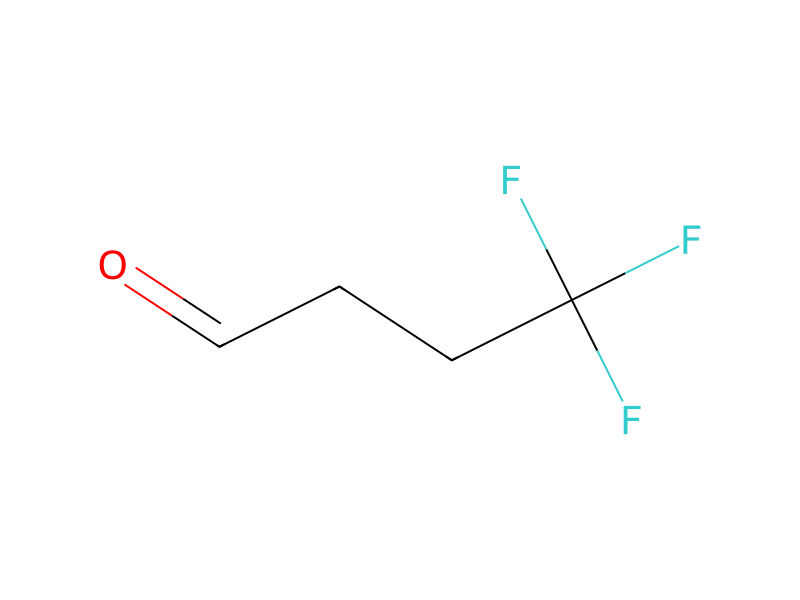
Product 1

Reagents, catalysts & solvents 3



Procedure
To a −78° C. solution of oxalyl chloride (4.13 mL, 47.4 mmol) in 60 mL of dichloromethane was added dimethylsulfoxide (4.76 mL, 67.1 mmol). After 10 minutes, 4,4,4-trifluorobutanol was added dropwise (5.059 g, 39.49 mmol), followed by dropwise addition of triethylamine (11.01 mL, 78.9 mmol). The solution was alowed to warm to room temperature over 30 minutes, and was quenched by the addition of saturated NH4Cl solution. The organic layer was separated and washed with brine to provide a solution of 4,4,4-trifluoro-1-butanal. To a second solution containing triphenylphosphine (31.1 g, 118 mmol) and carbontetrabromide (19.65 g, 59.2 mmol) in 50 mL of dichloromethane a 0° C. was added dropwise the aldehyde solution described above. Five minutes after complete addition, the reaction was diluted with 250 mL of hexane and 500 mL of water. The Organic layer was dried (Na2SO4), filtered, and concentrated in vacuo. The resulting material was triturated repeatedly with diethyl ether to remove triphenylphosphine oxide, giving the titled product.
Workup
- additionFive minutes after complete addition
- dry with materialThe Organic layer was dried (Na2SO4)
- filtrationfiltered
- concentrationconcentrated in vacuo
- customThe resulting material was triturated repeatedly with diethyl ether
- customto remove triphenylphosphine oxide
Sources & evidence
- ORD record
- ord-cc423f5fbad24effa8896809f8dbd86c
- Source dataset
- uspto-grants-2003_05
- Patent number
- US06562823B1
Reaction notes
Loading…