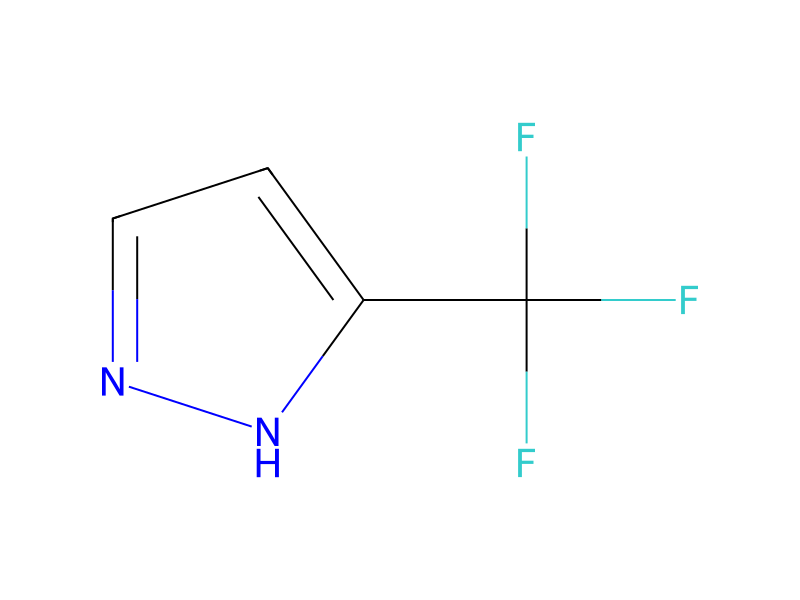
3-(Trifluoromethyl)pyrazole → 4,8-dichloro-7-methoxy-2-(3-(trifluoromethyl)-1H-pyrazol-1-yl)quinoline
Reaction equation

Cl[C:2]1[CH:11]=[C:10]([Cl:12])[C:9]2[C:4](=[C:5]([Cl:15])[C:6]([O:13][CH3:14])=[CH:7][CH:8]=2)[N:3]=1.[F:16][C:17]([F:24])([F:23])[C:18]1[CH:22]=[CH:21][NH:20][N:19]=1>>[Cl:12][C:10]1[C:9]2[C:4](=[C:5]([Cl:15])[C:6]([O:13][CH3:14])=[CH:7][CH:8]=2)[N:3]=[C:2]([N:20]2[CH:21]=[CH:22][C:18]([C:17]([F:24])([F:23])[F:16])=[N:19]2)[CH:11]=1Participants
3


Conditions
- Temperature
- 120 °C
Procedure
A mixture of compound 45d (5 g, 19 mmol) and 3-trifluoromethylpyrazole 86a (7.76 g, 57 mmol) was heated at 120° C. for 4-6 hrs and the reaction was followed by LCMS and TLC. The reaction mixture was purified by silica gel column (mono and dipyrazole were separated) using DCM and heptane as mobile phase to yield compound 119b (3.5 g) in 51% yield.
Workup
- customThe reaction mixture was purified by silica gel column (mono and dipyrazole were separated)
Sources & evidence
- ORD record
- ord-c38cac5e0432456aac828bda7a786016
- Source dataset
- uspto-grants-2012_01
- Patent number
- US08093379B2
Reaction notes
Loading…