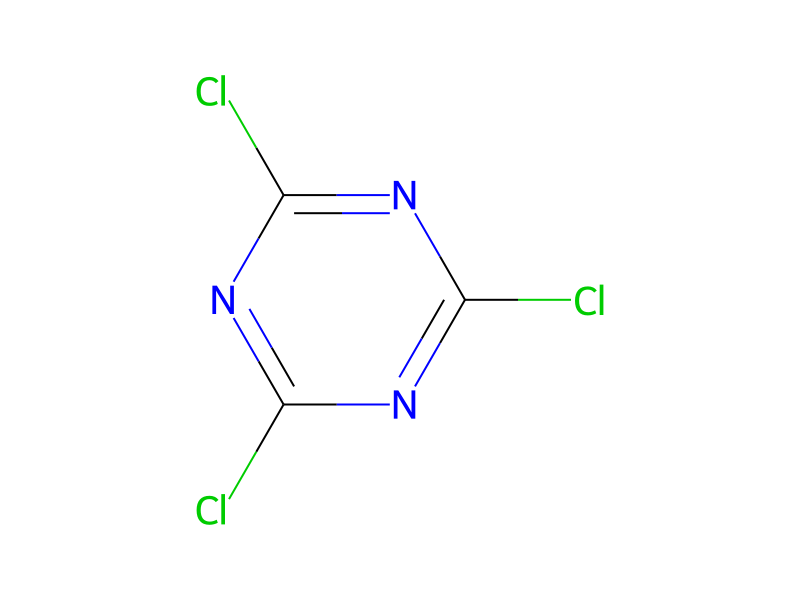
Cyanuric chloride → N,N',N''-Tris-(3'-azidopropyl)-[1,3,5]triazine-2,4,6-triamine
Reaction equation

[N:1]1[C:8](Cl)=[N:7][C:5](Cl)=[N:4][C:2]=1Cl.[N:10]([CH2:13][CH2:14][CH2:15][NH2:16])=[N+:11]=[N-:12]>>[N:10]([CH2:13][CH2:14][CH2:15][NH:16][C:2]1[N:4]=[C:5]([NH:16][CH2:15][CH2:14][CH2:13][N:10]=[N+:11]=[N-:12])[N:7]=[C:8]([NH:16][CH2:15][CH2:14][CH2:13][N:10]=[N+:11]=[N-:12])[N:1]=1)=[N+:11]=[N-:12]Participants
3


Procedure
FIG. 6 is a series of schemes showing the synthesis of the monomers used in the adhesives test. The first reaction to make 1 is an N-sulfonylation of the nitrogen mustard, N,N-di(2-chloroethyl) amine, followed by an SN2 displacement of the chlorides to obtain the diazide, 1. The second reaction is an N-propargylation of 4-methyl-benzenesulfonamide under mild conditions to give the diacetylene, 2. The last reaction is the displacement of the chlorides of cyanuric chloride with 3-azidopropylamine to give the triamino-1,3,5-triazine 5.
Workup
- customThe last reaction
Sources & evidence
- ORD record
- ord-1a7b928f1d7b439a86576cc57df4ac77
- Source dataset
- uspto-grants-2012_01
- Patent number
- US08101238B2
Reaction notes
Loading…