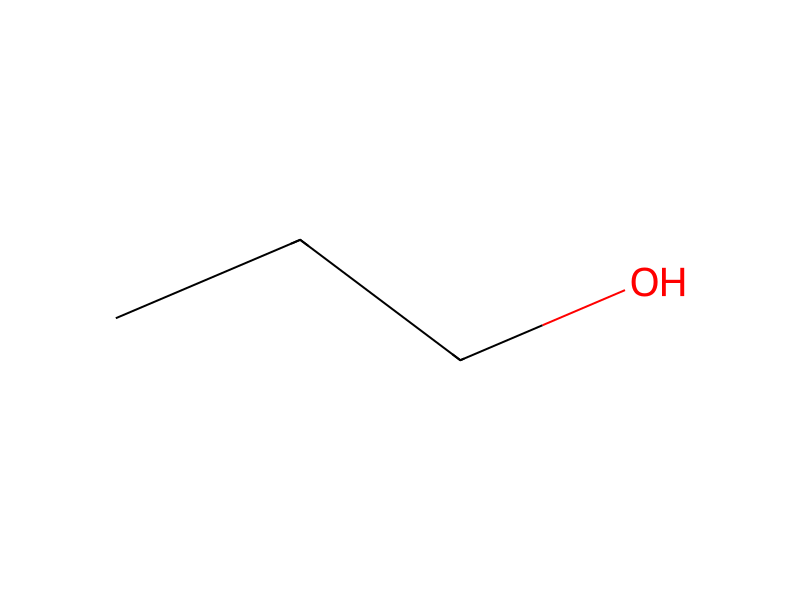
1-Propanol → 9-(2-cyclohexenyl)-2-propoxy-9H-adenine
Reaction equation

Cl[C:2]1[N:10]=[C:9]2[C:5]([N:6]=[CH:7][N:8]2[CH:11]2[CH2:16][CH2:15][CH2:14][CH:13]=[CH:12]2)=[C:4]([NH2:17])[N:3]=1.[CH2:18]([OH:21])[CH2:19][CH3:20]>>[CH:11]1([N:8]2[CH:7]=[N:6][C:5]3[C:9]2=[N:10][C:2]([O:21][CH2:18][CH2:19][CH3:20])=[N:3][C:4]=3[NH2:17])[CH2:16][CH2:15][CH2:14][CH:13]=[CH:12]1Participants
3


Procedure
A solution of 2.4 g. (9.2 mmoles) of 2-chloro-9-(2-cyclohexenyl)-9H-adenine in 60 ml. of 1 N sodium n-propoxide in n-propanol was heated at reflux overnight under a nitrogen atmosphere. The reaction mixture was poured into ice-water containing sufficient acetic acid to neutralize the excess alkoxide. The mixture was evaporated in vacuo. The residue was dissolved into CHCl3 with stirring. The CHCl3 extracts were washed with water, dried with Na2SO4 and evaporated to give 2.35 g. (90%) of title product; m.p. 157°-159° C. IR(KBr): 3450, 3110, 1630, 1585, 1470, 1390, 1335 cm-1. UV: λmaxMeOH 266 nm (ε 13200). NMR(CDCl3): δ 1.03 (3H, t, 7 Hz), 1.80(8H, m). 4.15(2H, t, J=7 Hz), 5.03 (2H, m), 5.88(1H, m), 6.56(2H, m), 7.4(1H, s).
Workup
- temperatureat reflux overnight under a nitrogen atmosphere
- customThe mixture was evaporated in vacuo
- dissolutionThe residue was dissolved into CHCl3
- washThe CHCl3 extracts were washed with water
- dry with materialdried with Na2SO4
- customevaporated
- customto give 2.35 g
Sources & evidence
- ORD record
- ord-d7023821195443a799a5ab63a8a29240
- Source dataset
- uspto-grants-1979_10
- Patent number
- US04172829
Reaction notes
Loading…