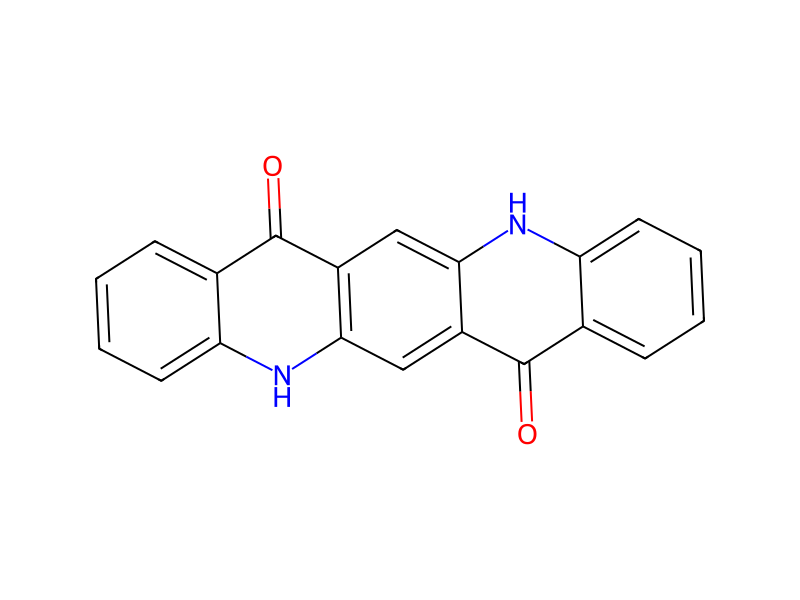
2,5-Dianilinoterephthalic acid → Quinacridone
Reaction equation

[NH:1]([C:8]1[CH:16]=[C:15]([C:17](O)=[O:18])[C:14]([NH:20][C:21]2[CH:26]=[CH:25][CH:24]=[CH:23][CH:22]=2)=[CH:13][C:9]=1[C:10](O)=[O:11])[C:2]1[CH:7]=[CH:6][CH:5]=[CH:4][CH:3]=1.ClC1C=C(C=CC=1)NC1C=C(C(O)=O)C(NC2C=CC=C(Cl)C=2)=CC=1C(O)=O>>[CH:24]1[CH:25]=[C:26]2[C:17]([C:15]3[C:14]([NH:20][C:21]2=[CH:22][CH:23]=1)=[CH:13][C:9]1[C:10]([C:7]2[C:2]([NH:1][C:8]=1[CH:16]=3)=[CH:3][CH:4]=[CH:5][CH:6]=2)=[O:11])=[O:18]Participants


Conditions
- Temperature
- 125 °C
Procedure
1000 parts of polyphosphoric acid containing 83.0% P2O5 are metered into a stirred vessel. Then 180 parts of 2,5-dianilinoterephthalic acid and 20 parts of 2,5-di(3-chloroanilino) terephthalic acid are introduced at 90° C. with stirring over 60 minutes. During this addition the temperature rises to 115° C. The mixture is heated to 125° C. and stirred at 125° C. for 1 hour during which ring closure takes place to form the quinacridone. The reaction mixture is subsequently metered into a static mixer ®Kenics KMR (length 10 cm, diameter 9 mm, 8 elements, supplier: H. Ott, Neckargmüind) with a volume flow of 2.1 parts by volume per hour, into a volume flow of 44.5 parts by volume per hour of 85% strength phosphoric acid at 140° C., and is hydrolyzed in 0.34 second with the formation of a precipitate. The phosphoric acid concentration after the hydrolysis is 93%. This gives 6445 parts of crude pigment suspension. 6279 parts of crude pigment suspension are cooled to 120° C. and 4479 parts of 40% strength phosphoric acid at 25° C. are run in with stirring. Following the addition of phosphoric acid, the phosphoric acid concentration is 70%. The mixture is stirred at 120° C. for 3 hours. Subsequently, the crude mixed crystal pigment is diluted with 10,000 parts of water, filtered off with suction, washed to neutrality with water and dried at 80° C. This gives 102.6 parts of crude mixed crystal pigment.
Workup
- additionDuring this addition the temperature
- customrises to 115° C
- stirringstirred at 125° C. for 1 hour during which ring closure
Sources & evidence
- ORD record
- ord-96434a85c5c74e248b9d0843f0c71406
- Source dataset
- uspto-grants-2001_11
- Patent number
- US06312512B1
Reaction notes
Loading…