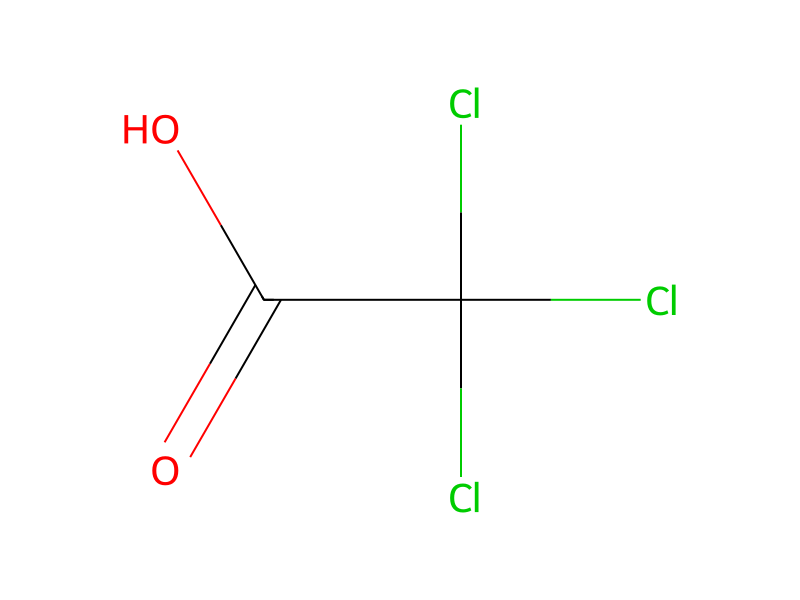
Trichloroacetic Acid → 2,2,3,3,4,4,5,5,6,6-Decafluoro-1-(trichloromethyl)-1-cyclohexanol
Reaction equation

[F:1][C:2]1([F:17])[C:7]([F:9])([F:8])[C:6]([F:11])([F:10])[C:5]([F:13])([F:12])[C:4]([F:15])([F:14])[C:3]1=[O:16].[Cl:18][C:19]([Cl:24])([Cl:23])C(O)=O>CN(C)P(N(C)C)(N(C)C)=O>[F:1][C:2]1([F:17])[C:7]([F:9])([F:8])[C:6]([F:10])([F:11])[C:5]([F:12])([F:13])[C:4]([F:14])([F:15])[C:3]1([C:19]([Cl:24])([Cl:23])[Cl:18])[OH:16]Participants
Reactant 2

Product 1

Reagents, catalysts & solvents 1

Conditions
- Temperature
- -10 °C
Procedure
A solution of 30 g of perfluorocyclohexanone and 31.7 g of trichloroacetic acid was stirred in a pre-dried reaction vessel containing 113 mL of hexamethylphosphoramide. This mixture was cooled to −10° C. in a dry ice/acetone bath. Slight gas evolution was noted before and during the ketone addition. The stirred milky white reaction mixture was maintained at about 0° C. for an hour and then allowed to warm to 23° C. and stirring was continued 17 hours. The clear yellow solution was quenched with 150 mL of 10% HCl and then transferred to a separatory funnel with 400 mL of ethyl ether. This organic phase was washed with 4×500 mL of dilute HCl and then 300 mL of saturated NaCl solution. The solvent was removed by evaporation. The residue (33.7 g) contained 40.8% product by GC, confirmed by fluorine NMR. This carbinol can be converted to the corresponding acrylate by methods previously described (cf. Example 24).
Workup
- temperatureThe stirred milky white reaction mixture was maintained at about 0° C. for an hour
- temperatureto warm to 23° C.
- customThe clear yellow solution was quenched with 150 mL of 10% HCl
- customtransferred to a separatory funnel with 400 mL of ethyl ether
- washThis organic phase was washed with 4×500 mL of dilute HCl
- customThe solvent was removed by evaporation
Sources & evidence
- ORD record
- ord-5c55fb8d56554b9a8804037f208ad620
- Source dataset
- uspto-grants-2001_11
- Patent number
- US06313245B1
Reaction notes
Loading…