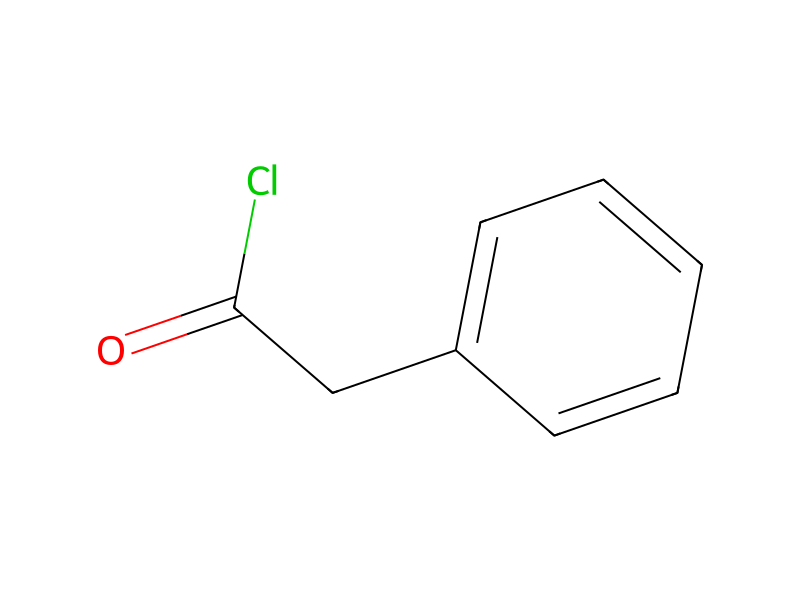
Phenylacetyl chloride → (4S)-3-(2-Phenylacetyl)-4-(phenylmethyl)-2-oxazolidinone
Reaction equation

[CH2:1]([C@H:8]1[CH2:12][O:11][C:10](=[O:13])[NH:9]1)[C:2]1[CH:7]=[CH:6][CH:5]=[CH:4][CH:3]=1.C([Li])CCC.[C:19]1([CH2:25][C:26](Cl)=[O:27])[CH:24]=[CH:23][CH:22]=[CH:21][CH:20]=1.C(OCC)(=O)C.CCCCCC>O1CCCC1>[CH2:1]([C@H:8]1[CH2:12][O:11][C:10](=[O:13])[N:9]1[C:26](=[O:27])[CH2:25][C:19]1[CH:24]=[CH:23][CH:22]=[CH:21][CH:20]=1)[C:2]1[CH:3]=[CH:4][CH:5]=[CH:6][CH:7]=1Participants





Procedure
Combine (S)-4-benzyl-2-oxazolidinone (22.9 g, 129 mmol) and tetrahydrofuran (120 mL). Cool in a dry-ice/acetone bath. Add dropwise a solution of n-butyl lithium (52 mL, 2.5 M, 130 mmol). After 15 minutes, slowly add a solution of phenylacetyl chloride (20 g, 129.4 mmol) in tetrahydrofuran (50 mL). After 20 minutes, warm to ambient temperature. After 2 hours, quench the reaction mixture by the addition of a saturated aqueous sodium bicarbonate solution. Separate the layers and extract the aqueous layer with diethyl ether. Combine the organic layers, dry over Na2SO4, filter, and evaporate in vacuo to give a residue. Chromatograph the residue on silica gel eluting with 15% ethyl acetate/hexane. Combine the product containing fractions, evaporate, and recrytallize from diethyl ether/hexane to give (S)-4-benzyl-3-phenylacetyl-2-oxazolidinone.
Workup
- temperatureCool in a dry-ice/acetone bath
- waitAfter 20 minutes
- waitAfter 2 hours
- customquench the reaction mixture
- additionby the addition of a saturated aqueous sodium bicarbonate solution
- customSeparate the layers
- extractionextract the aqueous layer with diethyl ether
- dry with materialdry over Na2SO4
- filtrationfilter
- customevaporate in vacuo
- customto give a residue
- additioncontaining fractions
- customevaporate
Sources & evidence
- ORD record
- ord-26e9eb1506c448fc933b0a08c6114af0
- Source dataset
- uspto-grants-2001_11
- Patent number
- US06316445B1
Reaction notes
Loading…