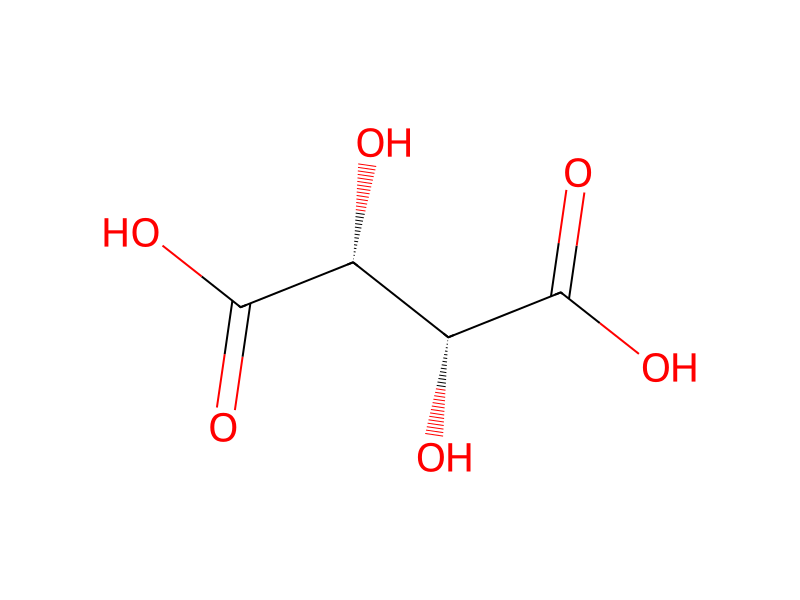
2,3-Dihydroxybutanedioic Acid → 3-[4-(2-Pyridyl)piperidin-1-yl]propylamine l-tartrate salt
Reaction equation

[N:1]1[CH:6]=[CH:5][CH:4]=[CH:3][C:2]=1[CH:7]1[CH2:12][CH2:11][N:10]([CH2:13][CH2:14][CH2:15][NH2:16])[CH2:9][CH2:8]1.[C:17]([OH:26])(=[O:25])[C@@H:18]([C@H:20]([C:22]([OH:24])=[O:23])[OH:21])[OH:19].C(O)(=O)C(C(C(O)=O)O)O>C(O)C>[C:22]([C@@H:20]([C@H:18]([C:17]([OH:26])=[O:25])[OH:19])[OH:21])([OH:24])=[O:23].[N:1]1[CH:6]=[CH:5][CH:4]=[CH:3][C:2]=1[CH:7]1[CH2:8][CH2:9][N:10]([CH2:13][CH2:14][CH2:15][NH2:16])[CH2:11][CH2:12]1Participants
5




Procedure
A solution of 3-[4-(2-pyridyl)piperidin-1-yl]propylamine, (6), (637.9 g, 3.86 mol) in ethanol (8.5 L) was warmed to 65° C. A solution of L-tartaric acid (637.9 g, 4.25 mol) in ethanol (2.23 L) was added in portions. Approximately 15% of the tartaric acid solution was added and then reaction mixture was aged for 1 hour to afford a thin slurry of crystalline material. The remaining tartaric acid solution was added dropwise. Heating was discontinued and the solution was slowly cooled to ambient temperature overnight. The solids were filtered, rinsed with ethanol (2×1 L) and dried under a stream of nitrogen to afford 3-[4-(2-pyridyl)piperidin-1-yl]propylamine L-tartrate salt, (7), as a pale yellow solid.
Workup
- customreaction mixture
- customto afford a thin slurry of crystalline material
- temperatureHeating
- filtrationThe solids were filtered
- washrinsed with ethanol (2×1 L)
- customdried under a stream of nitrogen
Sources & evidence
- ORD record
- ord-b42109ac54cf43b2b9777bd9c1d495e6
- Source dataset
- uspto-grants-2001_11
- Patent number
- US06320049B1
Reaction notes
Loading…