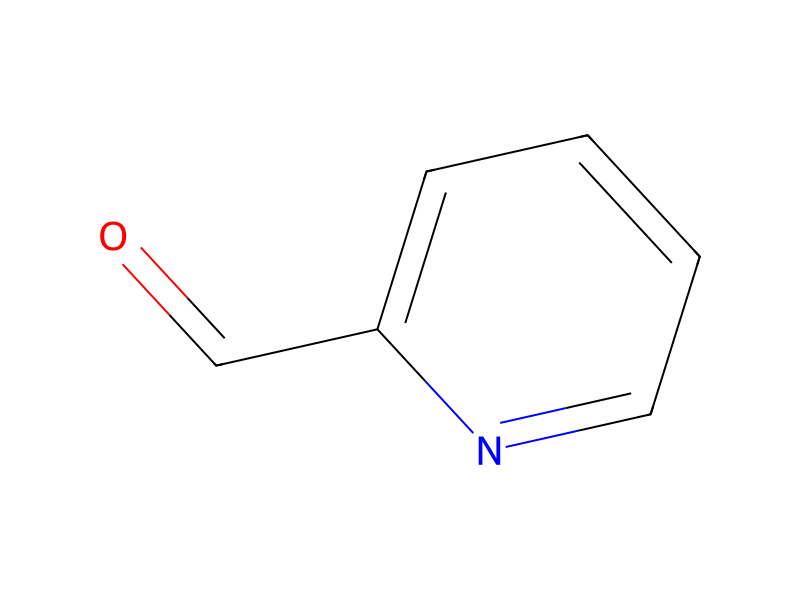
2-Pyridinecarboxaldehyde → HCID 6849020, compound
Reaction equation

[NH:1]1[C:13]2[NH:12][C:11]3[C:6](=[CH:7][CH:8]=[CH:9][CH:10]=3)[C:5]=2[N:4]=[N:3][C:2]1=[N:14][NH2:15].[N:16]1[CH:21]=[CH:20][CH:19]=[CH:18][C:17]=1[CH:22]=O>C(O)C>[N:16]1[CH:21]=[CH:20][CH:19]=[CH:18][C:17]=1[CH:22]=[N:15][NH:14][C:2]1[N:3]=[N:4][C:5]2[C:6]3[C:11](=[CH:10][CH:9]=[CH:8][CH:7]=3)[NH:12][C:13]=2[N:1]=1Participants
4
Reactant 2

Product 1

Reagents, catalysts & solvents 1

Conditions
- Temperature
- 60 °C
Procedure
To a solution of (1,9-Dihydro-1,3,4,9-tetraaza-fluoren-2-ylidene)-hydrazine 14d (27 mmol, 1 equiv.) in ethanol (50 mL) is added 2-pyridinecarboxaldehyde (27 mmol, 1 equiv.). The mixture is heated at 60° C. for 10 hours. The solution is allowed to cool to room temperature. The product is filtered and dried under vacuum for 15 hours. N-Pyridin-2-ylmethylene-N′-(9H-1,3,4,9-tetraaza-fluoren-2-yl)-hydrazine 14e is obtained as a pale yellow solid.
Workup
- temperatureto cool to room temperature
- filtrationThe product is filtered
- customdried under vacuum for 15 hours
Sources & evidence
- ORD record
- ord-8eff193429cb452b94562452bed9862f
- Source dataset
- uspto-grants-2003_12
- Patent number
- US06660737B2
Reaction notes
Loading…