3-Phenoxybenzyl alcohol → (2-Bromo-5-phenoxyphenyl)methanol
Reaction equation

[O:1]([C:8]1[CH:9]=[C:10]([CH2:14][OH:15])[CH:11]=[CH:12][CH:13]=1)[C:2]1[CH:7]=[CH:6][CH:5]=[CH:4][CH:3]=1.[Br:16]N1C(=O)CCC1=O>C(#N)C>[Br:16][C:11]1[CH:12]=[CH:13][C:8]([O:1][C:2]2[CH:3]=[CH:4][CH:5]=[CH:6][CH:7]=2)=[CH:9][C:10]=1[CH2:14][OH:15]Participants
Reactant 2
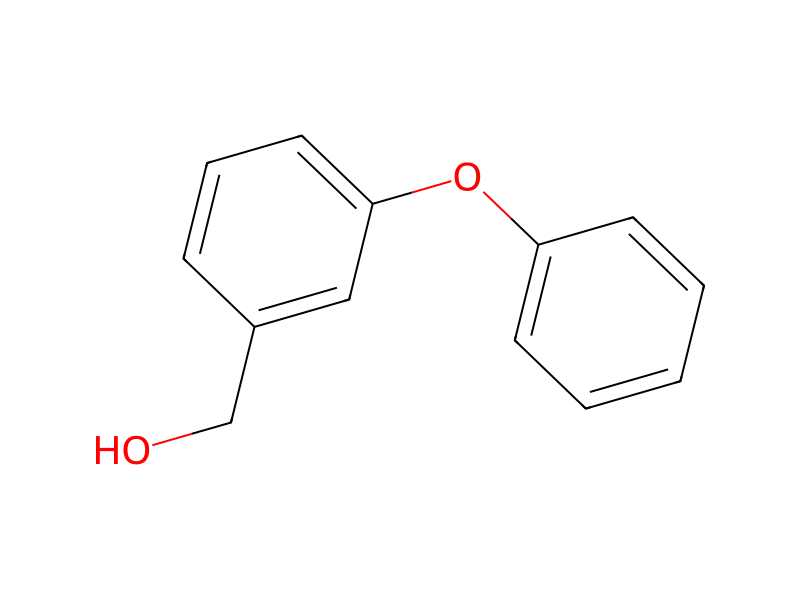

Product 1

Reagents, catalysts & solvents 1

Procedure
To a solution of 3-phenoxyphenyl methanol (4.0 g, 0.020 mol) in anhydrous acetonitrile was added 1-bromo-2,5-pyrrolidinedione (3.73 g, 0.021 mol) at room temperature. The mixture was stirred at room temperature for one and a half hour under an atmosphere of nitrogen. The solvents were removed under the reduced pressure. Tetrachloromethane (100 mL) was added to the residue, and the mixture was filtered. The filtrate was concentrated into the residue, and the residue was purified by flash chromatography on silica gel using ethyl acetate/n-heptane (1:5) as mobile phase to yield (2-bromo-5-phenoxyphenyl)methanol (4.7 g, 0.017 mol): RP-HPLC (Hypersil C18, 5 μm, 250×4.6 mm; 25%-100% over 10 min with 0.1 M ammonium acetate, 1 mL/min) Rt 11.7 min. TLC (ethyl acetate/heptane 1:5) Rf 0.18.
Workup
- customThe solvents were removed under the reduced pressure
- additionTetrachloromethane (100 mL) was added to the residue
- filtrationthe mixture was filtered
- concentrationThe filtrate was concentrated into the residue
- customthe residue was purified by flash chromatography on silica gel
Sources & evidence
- ORD record
- ord-e6881106d19a47819921a3fd29407149
- Source dataset
- uspto-grants-2003_12
- Patent number
- US06660744B1
Reaction notes
Loading…