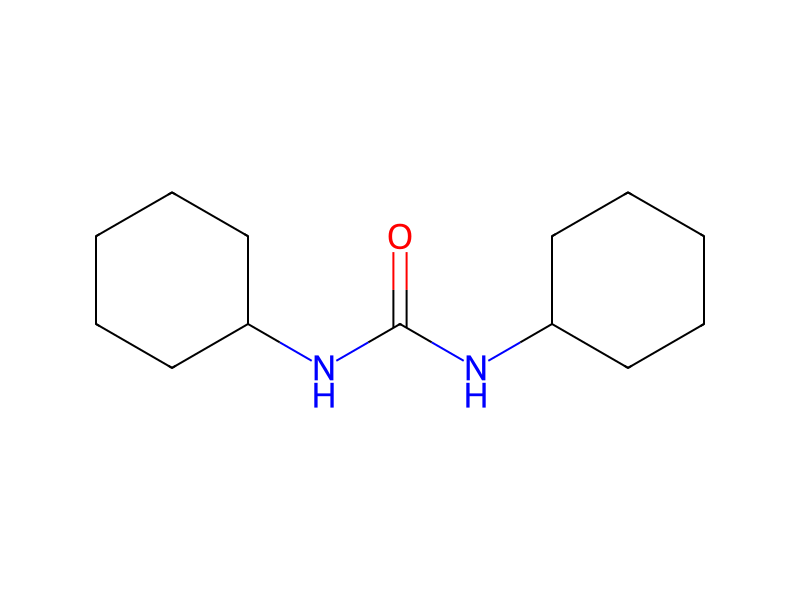
Dicyclohexylcarbodiimide → N,N'-Dicyclohexylurea
Reaction equation

[CH:1]1([N:7]=[C:8]=[N:9][CH:10]2[CH2:15][CH2:14][CH2:13][CH2:12][CH2:11]2)[CH2:6][CH2:5][CH2:4][CH2:3][CH2:2]1.[OH:16]C1C=CC(C(O[C@H](C)CCCCCC)=O)=CC=1F>CN(C)C1C=CN=CC=1.ClCCl>[C:8]([NH:7][CH:1]1[CH2:2][CH2:3][CH2:4][CH2:5][CH2:6]1)([NH:9][CH:10]1[CH2:15][CH2:14][CH2:13][CH2:12][CH2:11]1)=[O:16]Participants
5
Reactant 2


Product 1
Reagents, catalysts & solvents 2


Procedure
N,N′-Dicyclohexylcarbodiimide (0.64 g, 3.1 mmol) and 4-(dimethylamino)pyridine (0.10 g, 0.1 mmol) was added to a stirred solution of compound 42 (1.23 g, 3.1 mmol) and compound 15 (0.83 g, 3.1 mmol) in dichloromethane. The reaction mixture was left stirring at room temperature for 72 h until completion of the reaction. Tile dicyclohexylurea formed was filtered off and the solvent removed in vacuo to yield a viscous colourless oil which was purified by column chromatography (ethyl acetate) on silica. The colourless material was then heated in ethanol and cooled to −60°, filtered off and dried in vacuo (P2O5). Yield 1.83 g (91%), [α]D=−22.35° at 24° C.
Workup
- waitThe reaction mixture was left
Sources & evidence
- ORD record
- ord-b4b6daf228fd43df97f08856998e89cf
- Source dataset
- uspto-grants-2003_12
- Patent number
- US06666989B1
Reaction notes
Loading…