L-Tartaric acid → HCID 22042229, compound
Reaction equation

[C:1]([OH:10])(=[O:9])[C@@H:2]([C@H:4]([C:6]([OH:8])=[O:7])[OH:5])[OH:3].FC1C=CC(C2(O)ONC(CN3CCC(N4C5C=CC(Cl)=CC=5NC4=O)CC3)=C2O)=CC=1>C(O)C.O>[OH2:3].[C:6]([CH:4]([CH:2]([C:1]([OH:10])=[O:9])[OH:3])[OH:5])([OH:8])=[O:7]Participants
5
Reactant 2
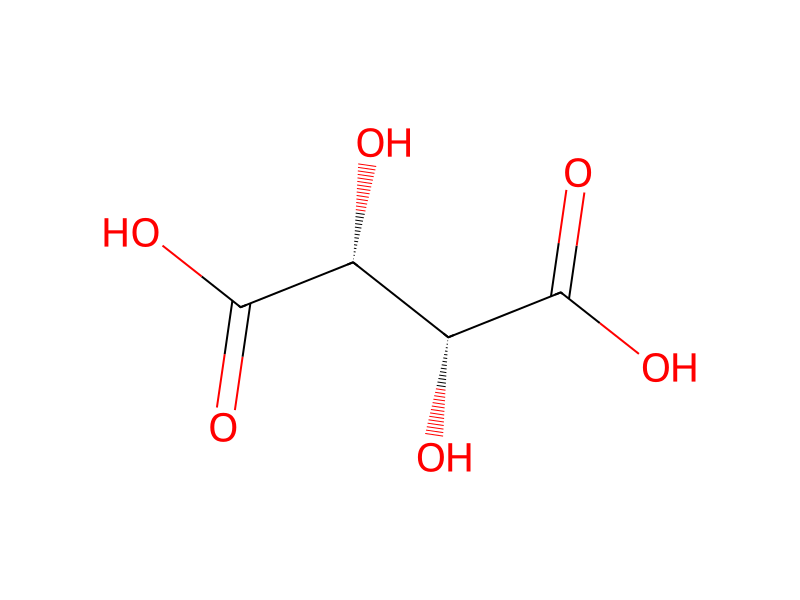

Product 1

Reagents, catalysts & solvents 2


Procedure
A 46.5 g-quantity of the above compound (free base) is dissolved in 200 ml of ethanol, and a solution of 15 g of L-tartaric acid in 200 ml of water is added to the ethanol solution. The resulting mixture is allowed to stand at room temperature. The crystals thus precipitated are recrystallized three times from ethanol-water (6:4) to give tartrate monohydrate as colorless prisms. The tartrate monohydrate is treated with an aqueous solution of sodium bicarbonate to give (-)-1-[5-(4-fluorophenyl)-4,5-dihydroisoxazol-3-ylmethyl]-4-(5-chloro-2-oxo-1-benzimidazolinyl)piperidine. Melting point: 143°-145° C. [α]D25 : -108.8 (chloroform).
Workup
- customto stand at room temperature
- customThe crystals thus precipitated
- customare recrystallized three times from ethanol-water (6:4)
Sources & evidence
- ORD record
- ord-87d9b87514c64c7ab521664c05549dda
- Source dataset
- uspto-grants-1983_08
- Patent number
- US04397853
Reaction notes
Loading…