Morpholine → 5-Morpholino-6-fluoro-8-nitroquinaldine
Reaction equation

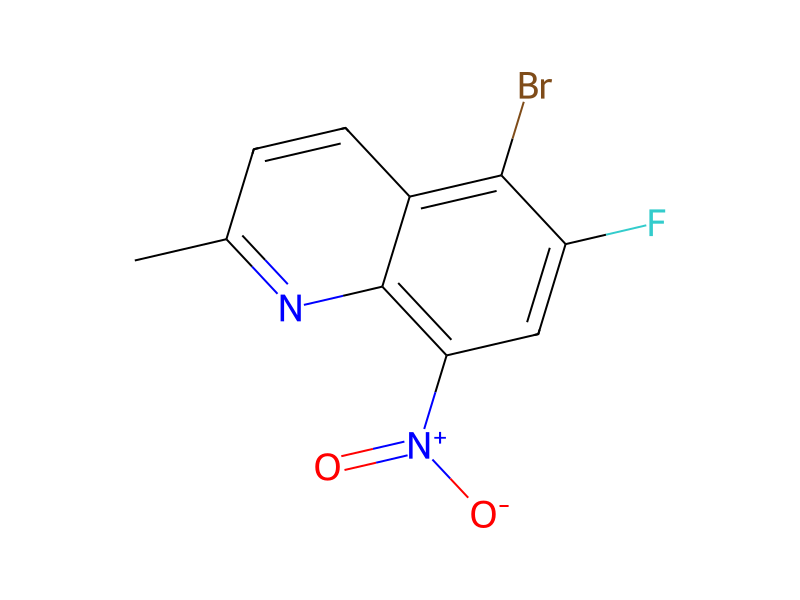
Br[C:2]1[C:11]([F:12])=[CH:10][C:9]([N+:13]([O-:15])=[O:14])=[C:8]2[C:3]=1[CH:4]=[CH:5][C:6]([CH3:16])=[N:7]2.[NH:17]1[CH2:22][CH2:21][O:20][CH2:19][CH2:18]1>CN(C=O)C>[O:20]1[CH2:21][CH2:22][N:17]([C:2]2[C:11]([F:12])=[CH:10][C:9]([N+:13]([O-:15])=[O:14])=[C:8]3[C:3]=2[CH:4]=[CH:5][C:6]([CH3:16])=[N:7]3)[CH2:18][CH2:19]1Participants
4
Reactant 2

Product 1

Reagents, catalysts & solvents 1

Conditions
- Temperature
- 70 °C
Procedure
5-Bromo-6-fluoro-8-nitroquinaldine (9.0 g) and morpholine (13.7 g) were dissolved in 90 ml of DMF and the solution was stirred at an internal temperature of 70° C. for 6.5 hours. Excessive morpholine and DMF were distilled off under reduced pressure and n-hexane was added to the residue followed by sufficient stirring. Then, isopropanol was added to the solution to precipitate solids which then was collected by filtration. The solids were dissolved in water and the aqueous solution was rendered alkaline with an aqueous sodium hydroxide solution to precipitate solids, which were collected by filtration to give 3.3 g of 5-morpholino-6-fluoro-8-nitroquinaldine.
Workup
- distillationExcessive morpholine and DMF were distilled off under reduced pressure and n-hexane
- additionwas added to the residue
- additionThen, isopropanol was added to the solution
- customto precipitate solids which
- filtrationthen was collected by filtration
- dissolutionThe solids were dissolved in water
- customto precipitate solids, which
- filtrationwere collected by filtration
Sources & evidence
- ORD record
- ord-da5db2dbd0f3454baa9bf8efd78fcbaa
- Source dataset
- uspto-grants-1983_08
- Patent number
- US04399134
Reaction notes
Loading…