Quinoline → HCID 86734815, compound
Reaction equation

[Cl:1][CH2:2][C:3]1[C:16]2[CH:15]=[CH:14][C:13]3[C:8](=[CH:9][CH:10]=[CH:11][CH:12]=3)[C:7]=2[CH:6]=[CH:5][CH:4]=1.[N:17]1[C:26]2[C:21](=[CH:22][CH:23]=[CH:24][CH:25]=2)[CH:20]=[CH:19][CH:18]=1>C(O)(C)C>[Cl-:1].[C:3]1([CH2:2][N+:17]2[C:26]3[C:21](=[CH:22][CH:23]=[CH:24][CH:25]=3)[CH:20]=[CH:19][CH:18]=2)[C:16]2[CH:15]=[CH:14][C:13]3[C:8](=[CH:9][CH:10]=[CH:11][CH:12]=3)[C:7]=2[CH:6]=[CH:5][CH:4]=1Participants
4
Reactant 2
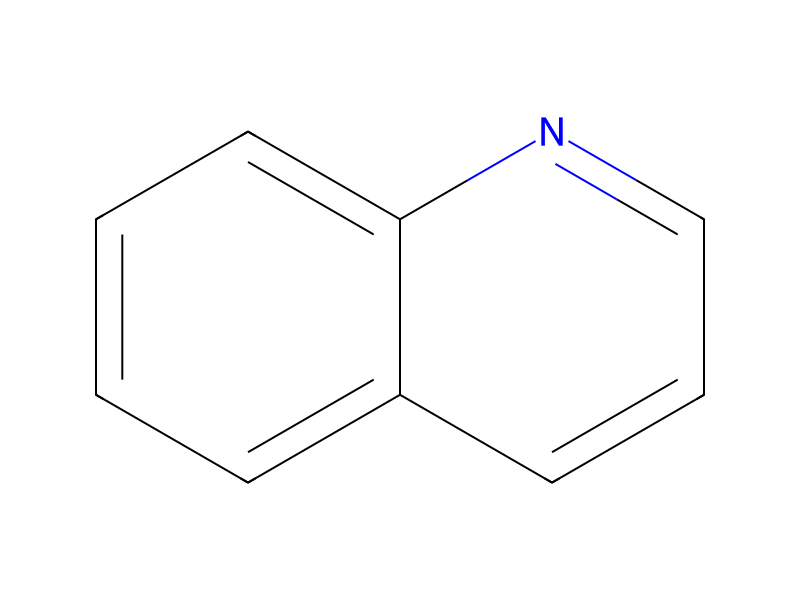

Product 1

Reagents, catalysts & solvents 1

Conditions
- Temperature
- 125 °C
Procedure
90 g. of the chloromethylphenanthrene prepared above was placed in a reaction vessel, along with 61.5 g. of crude quinoline. The resulting mixture was then stirred and heated to a temperature of 125° C. A total of 101 g. of isopropanol was weighed out and a portion of this was added to the reaction mixture to permit temperature maintenance of the reaction mixture by refluxing of the isopropanol portion. After the mixture had been held at 125° C. temperature for about 3 hours, the material was cooled to room temperature and the remainder of the isopropanol was added. This resulted in a 60% isopropanol solution of N-(phenanthrylmethyl) quinolinium chloride.
Workup
- customwas placed in a reaction vessel, along with 61.5 g
- additiona portion of this was added to the reaction mixture
- customhad been held at 125° C.
- customfor about 3 hours
- temperaturethe material was cooled to room temperature
Sources & evidence
- ORD record
- ord-3e1a98852b9d45ea9f2a0234b05721b2
- Source dataset
- uspto-grants-1977_06
- Patent number
- US04028268
Reaction notes
Loading…