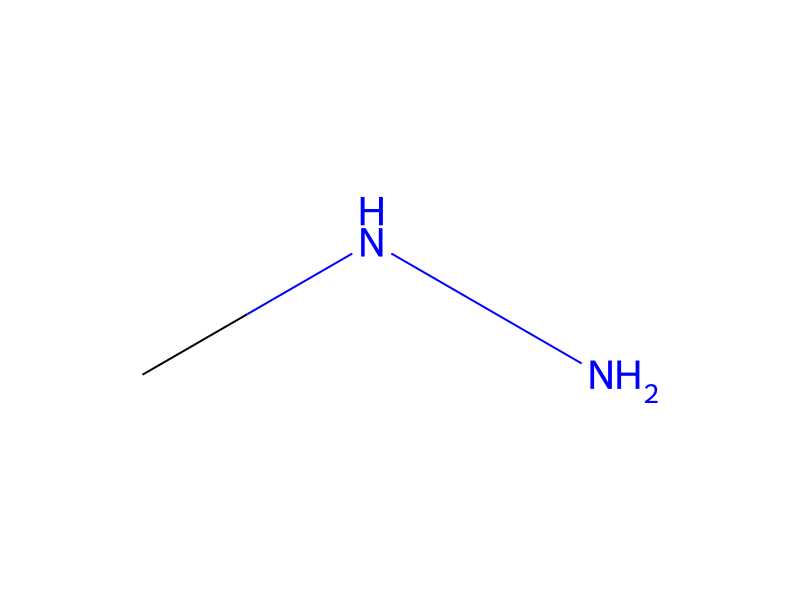
Methylhydrazine → 4-[1-(t-Butylazo)cyclohexyl]-2-methylthiosemicarbazide
Reaction equation

[C:1]([N:5]=[N:6][C:7]1([N:13]=[C:14]=[S:15])[CH2:12][CH2:11][CH2:10][CH2:9][CH2:8]1)([CH3:4])([CH3:3])[CH3:2].[CH3:16][NH:17][NH2:18].[N-]=C=S>CCCCC>[C:1]([N:5]=[N:6][C:7]1([NH:13][C:14](=[S:15])[N:17]([CH3:16])[NH2:18])[CH2:8][CH2:9][CH2:10][CH2:11][CH2:12]1)([CH3:4])([CH3:2])[CH3:3]Participants
5


Procedure
To 10.0 grams (.0434 moles) of 1-t-butylazo-1-isothiocyanatocyclohexane cooled to 5° C. and stirred with a magnetic stirrer in a 50 ml erlenmeyer flask was added 1.99 grams (.0434 moles) of methylhydrazine. The reaction was very exothermic and solids formed immediately. Pentane was added to form a slurry, the reaction mixture stirred for 30 minutes at room temperature and the pentane stripped from the slurry to leave a white solid weighing 10.7 grams (89% crude yield). The product melted at 118°-120° C. with decomposition and its infrared spectrum had a strong band at 1515 cm-1 ##STR22## moderate NH bands at 3225 cm-1 and the isothiocyanate at 2040 cm-1 was absent.
Workup
- customsolids formed immediately
- customto form a slurry
- stirringthe reaction mixture stirred for 30 minutes at room temperature
- customto leave a white solid
Sources & evidence
- ORD record
- ord-30cb7e0a54b64461b3e41d9ef8e33e01
- Source dataset
- uspto-grants-1977_06
- Patent number
- US04028344
Reaction notes
Loading…