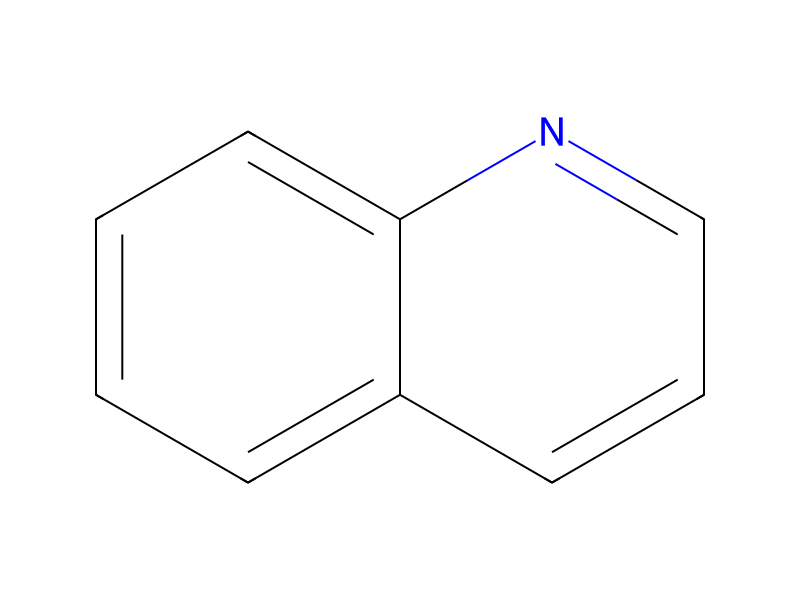
Quinoline → 3,7,11-Trimethyldodeca-1,6,10-trien-3-ol
Reaction equation

N1C2C(=CC=CC=2)C=CC=1.[CH3:11][C:12]([CH3:26])=[CH:13][CH2:14][CH2:15]/[C:16](/[CH3:25])=[CH:17]/[CH2:18][CH2:19][C:20]([OH:24])([C:22]#[CH:23])[CH3:21]>[Pd].[Pd].CC([O-])=O.CC([O-])=O.[Pb+2].CCCCCC>[OH:24][C:20]([CH2:19][CH2:18][CH:17]=[C:16]([CH2:15][CH2:14][CH:13]=[C:12]([CH3:26])[CH3:11])[CH3:25])([CH:22]=[CH2:23])[CH3:21]Participants
5
Reactant 2

Product 1

Reagents, catalysts & solvents 2


Procedure
Further, 0.5 ml of quinoline and 20 g of 0.25% Pd-Lindlar catalyst was added in a solution of 1,280 g of the said dehydronerolidol in 2,000 ml of n-hexane and the mixture was hydrogenated at room temperature and normal pressure. After post-treatment, the reaction mixture was subjected to vacuum distillation to give 1,170 g of nerolidol having b.p. 105° - 110° C. (0.5 mmHg).
Workup
- customwas hydrogenated at room temperature
- distillationAfter post-treatment, the reaction mixture was subjected to vacuum distillation
Sources & evidence
- ORD record
- ord-7d45f6fc1930445095d4e703d19bd850
- Source dataset
- uspto-grants-1977_06
- Patent number
- US04028385
Reaction notes
Loading…