Trityl chloride → 3-[(Triphenylmethyl)sulfanyl]propanoic acid
Reaction equation

[CH2:1]([C:4]([OH:6])=[O:5])[CH2:2][SH:3].[C:7]1([C:13](Cl)([C:20]2[CH:25]=[CH:24][CH:23]=[CH:22][CH:21]=2)[C:14]2[CH:19]=[CH:18][CH:17]=[CH:16][CH:15]=2)[CH:12]=[CH:11][CH:10]=[CH:9][CH:8]=1>C(Cl)Cl>[C:13]([S:3][CH2:2][CH2:1][C:4]([OH:6])=[O:5])([C:7]1[CH:12]=[CH:11][CH:10]=[CH:9][CH:8]=1)([C:20]1[CH:21]=[CH:22][CH:23]=[CH:24][CH:25]=1)[C:14]1[CH:15]=[CH:16][CH:17]=[CH:18][CH:19]=1Participants
4
Reactant 2
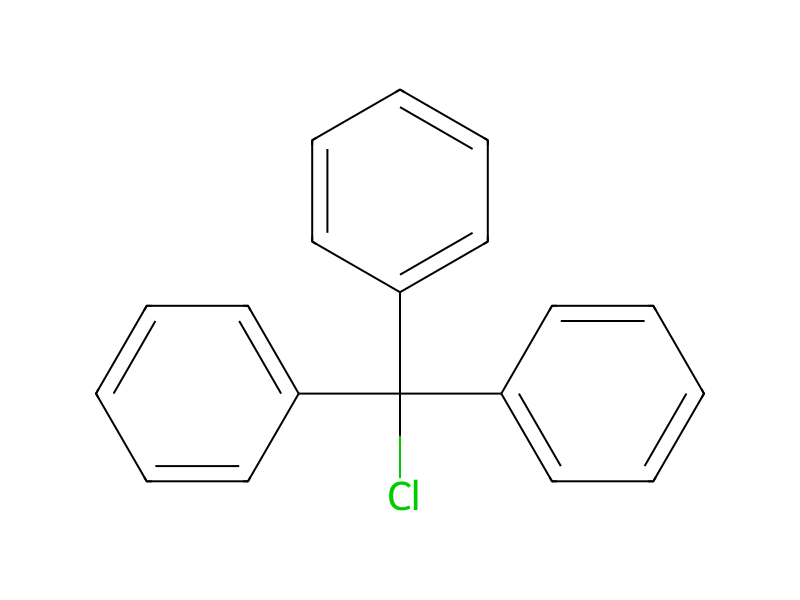

Product 1

Reagents, catalysts & solvents 1

Procedure
Mercaptopropionic acid 2 (3.14 g) was dissolved in 50 ml of methylene chloride. Triphenylmethylchloride 3 (8.36 g, 30 mmol) was added to that, and 19-hour protection reactions were carried out at room temperature. The precipitate generated through the protection reactions was filtered and gathered, and was rinsed with 40 ml of diethyl ether. The precipitate was then dried under reduced pressure, to form 9.86 g of 3-(tritylthio)propanoic acid 4, which is a white solid.
Workup
- customwere carried out at room temperature
- filtrationwas filtered
- washwas rinsed with 40 ml of diethyl ether
- customThe precipitate was then dried under reduced pressure
Sources & evidence
- ORD record
- ord-d22b357b1eb6472fa57171c45f1cc5ab
- Source dataset
- uspto-grants-2013_07
- Patent number
- US08475685B2
Reaction notes
Loading…