1-{[(3-Nitroquinolin-4-yl)amino]methyl}cyclobutanol → 1-{[(3-Aminoquinolin-4-yl)amino]methyl}cyclobutanol
Reaction equation
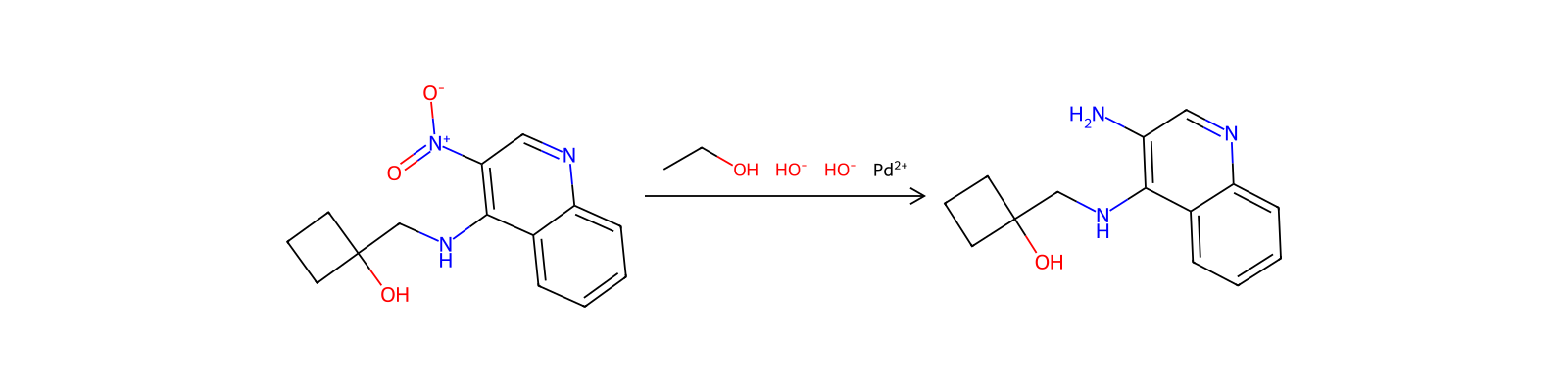
[N+:1]([C:4]1[CH:5]=[N:6][C:7]2[C:12]([C:13]=1[NH:14][CH2:15][C:16]1([OH:20])[CH2:19][CH2:18][CH2:17]1)=[CH:11][CH:10]=[CH:9][CH:8]=2)([O-])=O>CCO.[OH-].[OH-].[Pd+2]>[NH2:1][C:4]1[CH:5]=[N:6][C:7]2[C:12]([C:13]=1[NH:14][CH2:15][C:16]1([OH:20])[CH2:19][CH2:18][CH2:17]1)=[CH:11][CH:10]=[CH:9][CH:8]=2Participants
4
Reactant 1

Product 1

Reagents, catalysts & solvents 2


Procedure
A mixture of 1-{[(3-nitroquinolin-4-yl)amino]methyl}cyclobutanol (6.32 g, 23.1 mmol) and 20% palladium hydroxide on carbon (0.60 g) in EtOH (100 mL) was hydrogenated overnight on a Parr apparatus at 40 psi (2.8×10⁵ Pa). The mixture was filtered through CELITE filter agent, which was rinsed several times with EtOH, and the filtrate was concentrated to provide 1-{[(3-aminoquinolin-4-yl)amino]methyl}cyclobutanol as a pale yellow solid (5.66 g). The solid was concentrated from toluene and chloroform to remove ethanol before using directly in the next reaction.
Workup
- filtrationThe mixture was filtered through CELITE
- filtrationfilter agent, which
- washwas rinsed several times with EtOH
- concentrationthe filtrate was concentrated
Sources & evidence
- ORD record
- ord-a53e3dc001e44a21851e1825d4086b1c
- Source dataset
- uspto-grants-2013_09
- Patent number
- US08541438B2
Reaction notes
Loading…