Boron trifluoride etherate → 2,3-dihydro-1H-indol-5-ol
Reaction equation

[OH:1][C:2]1[CH:3]=[C:4]2[C:8](=[CH:9][CH:10]=1)[NH:7][CH:6]=[CH:5]2.C([BH3-])#N.[Na+].B(F)(F)F.CCOCC>CO>[OH:1][C:2]1[CH:3]=[C:4]2[C:8](=[CH:9][CH:10]=1)[NH:7][CH2:6][CH2:5]2Participants
Reactant 3

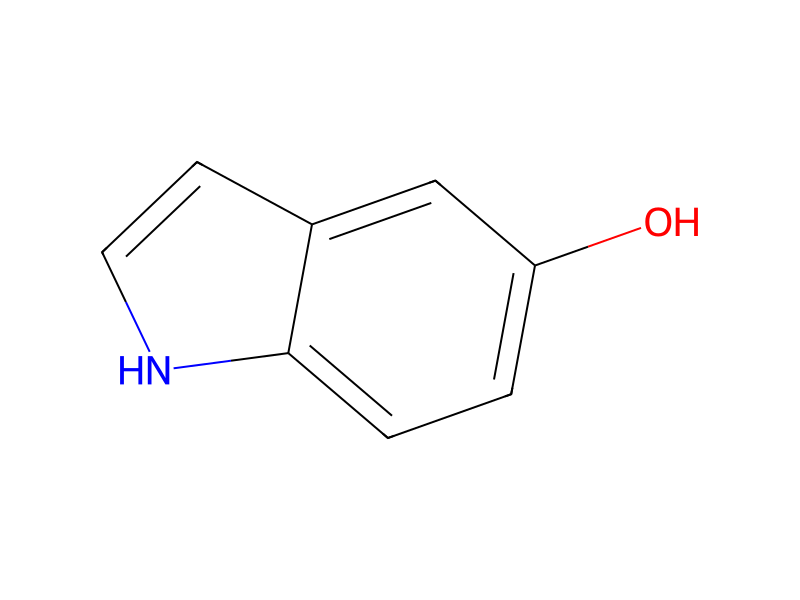

Product 1

Reagents, catalysts & solvents 1

Procedure
5-Hydroxyindole (2 g, 15 mmol) was dissolved in methanol (60 ml) under argon. Sodium cyanoborohydride (1.89 g, 30 mmol) and trifluoroboron etherate (4.2 ml, 33 mmol) were added and the mixture was heated at reflux for 3 hours then left to cool to ambient temperature. The solvent was evaporated and the residue was partitioned between ethyl acetate and water. Ammonia was added to adjust the pH to 10 and the aqueous phase was extracted with more ethyl acetate. The combined organic phases were washed with water, brine, dried (MgSO4), filtered and the solvent evaporated. The residue was purified by flash chromatography using dichloromethane/methanol (95/5) as solvent. Evaporation of the solvent gave 5-hydroxy-2,3-dihydro-1H-indole (1.45 g, 73%) as an off white solid.
Workup
- temperaturethe mixture was heated
- temperatureat reflux for 3 hours
- waitthen left
- customThe solvent was evaporated
- customthe residue was partitioned between ethyl acetate and water
- additionAmmonia was added
- extractionthe aqueous phase was extracted with more ethyl acetate
- washThe combined organic phases were washed with water, brine
- dry with materialdried (MgSO4)
- filtrationfiltered
- customthe solvent evaporated
- customThe residue was purified by flash chromatography
- customEvaporation of the solvent
Sources & evidence
- ORD record
- ord-b372ae32ecc046f1857ba9e2446e568d
- Source dataset
- uspto-grants-2013_07
- Patent number
- US08492560B2
Reaction notes
Loading…