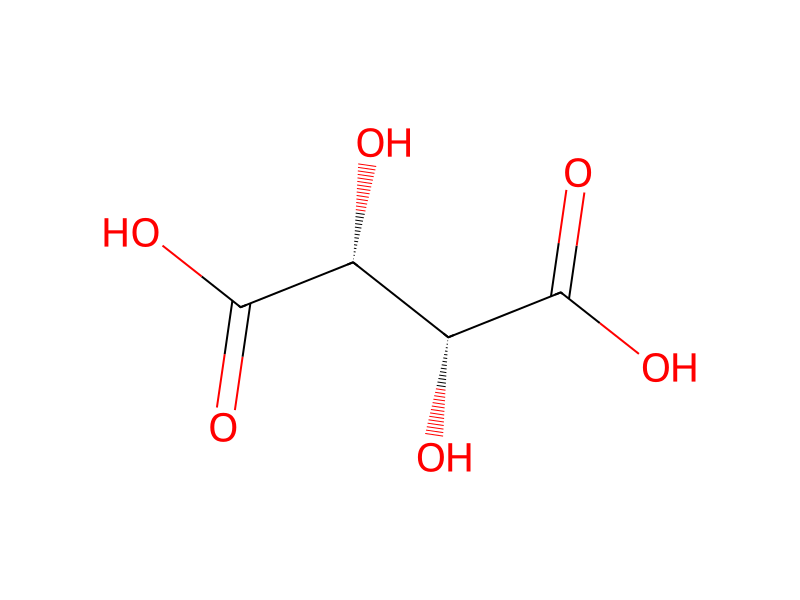
L-Tartaric acid → 2,3-Dihydroxybutanedioic Acid
Reaction equation

NCC1C=CC(F)=C(C2CCN(C(C3C4C(=C(F)C=CC=4OC(F)(F)F)N(CCOC)C=3)=O)CC2)C=1.[C:37]([OH:46])(=[O:45])[C@@H:38]([C@H:40]([C:42]([OH:44])=[O:43])[OH:41])[OH:39]>C(#N)C.O>[C:37]([OH:46])(=[O:45])[CH:38]([CH:40]([C:42]([OH:44])=[O:43])[OH:41])[OH:39]Participants
4


Conditions
- Temperature
- 60 °C
Procedure
[4-(5-aminomethyl-2-fluoro-phenyl)-piperidin-1-yl]-[7-fluoro-1-(2-methoxy-ethyl)-4-trifluoromethoxy-1H-indol-3-yl]-methanone (0.250 g, 0.554 mmol) was weighed in a 20 ml glass vial. A solution of L-(+)-tartaric acid at 2.66 mmol/ml in 5:1 (v/v) acetonitrile/water was prepared, and 0.2084 ml of this solution was added to the weighed solid with stirring and heating to ˜60° C. giving a clear solution. The solution was then evaporated in vacuo on a rotary evaporator leaving a glassy solid which was recrystallized in hot isopropyl acetate to which a minimum amount of isopropanol was added to give a clear solution. Upon cooling the crystalline product was isolated by filtration and dried in vacuo at room temperature.
Workup
- customgiving a clear solution
- customThe solution was then evaporated in vacuo on a rotary evaporator
- customleaving a glassy solid which
- customwas recrystallized in hot isopropyl acetate to which a minimum amount of isopropanol
- additionwas added
- customto give a clear solution
- temperatureUpon cooling the crystalline product
- customwas isolated by filtration
- customdried in vacuo at room temperature
Sources & evidence
- ORD record
- ord-87d341b0d6b24360984172ee02f7e402
- Source dataset
- uspto-grants-2013_07
- Patent number
- US08497379B2
Reaction notes
Loading…