Water → Ethyl 6-fluoro-7-(pyrrol-1-yl)-1-cyclopropyl-1,4-dihydro-4-oxoquinoline-3-carboxylate
Reaction equation
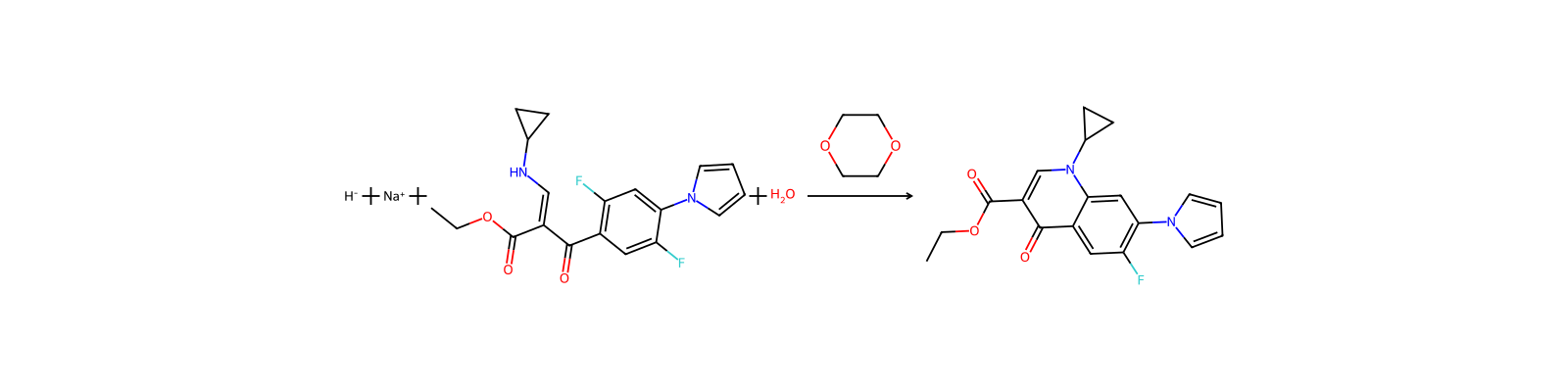
[H-].[Na+].[CH:3]1([NH:6][CH:7]=[C:8]([C:14](=[O:28])[C:15]2[CH:20]=[C:19]([F:21])[C:18]([N:22]3[CH:26]=[CH:25][CH:24]=[CH:23]3)=[CH:17][C:16]=2F)[C:9]([O:11][CH2:12][CH3:13])=[O:10])[CH2:5][CH2:4]1.O>O1CCOCC1>[F:21][C:19]1[CH:20]=[C:15]2[C:16](=[CH:17][C:18]=1[N:22]1[CH:26]=[CH:25][CH:24]=[CH:23]1)[N:6]([CH:3]1[CH2:5][CH2:4]1)[CH:7]=[C:8]([C:9]([O:11][CH2:12][CH3:13])=[O:10])[C:14]2=[O:28]Participants
5





Conditions
- Temperature
- 80 °C
Procedure
0.07 g (0.00115 mol) of a 60% suspension of sodium hydride in mineral oil is added to a solution of 0.41 g (0.00114 mol) of ethyl 3-cyclopropylamino-2-(2,5-difluoro-4-pyrrol-1-ylbenzoyl)acrylate in 10 ml of anhydrous dioxane. The mixture is heated at 80° C. for 2 hours under a nitrogen atmosphere and left to cool, 30 ml of water are added and the precipitate is filtered off and washed with water to give 0.3 g of a product melting at 216°-9° C.
Workup
- waitleft
- temperatureto cool
- filtrationthe precipitate is filtered off
- washwashed with water
Sources & evidence
- ORD record
- ord-0a1010327ec546d5a8e17196d15dca2f
- Source dataset
- uspto-grants-1988_02
- Patent number
- US04727080
Reaction notes
Loading…