3-Nitrophenylboronic Acid → 4-Nitrophenylboronic acid
Reaction equation

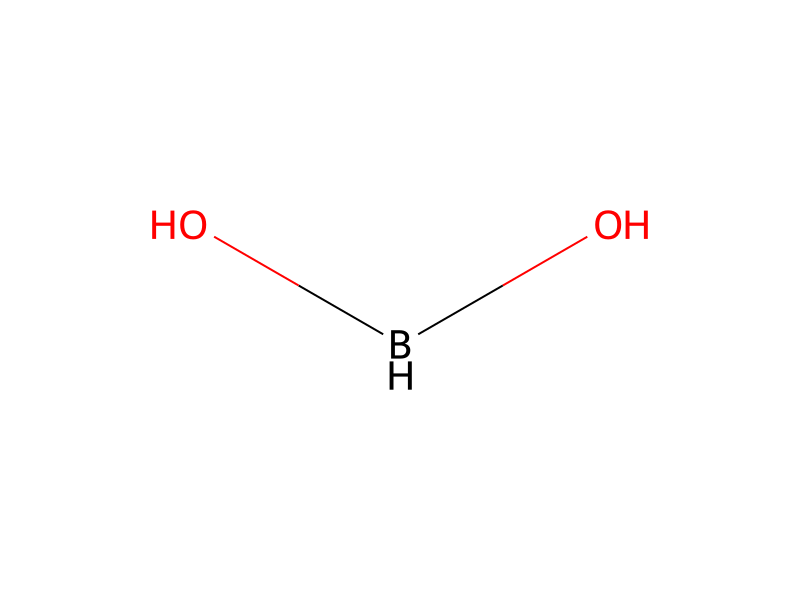
[C:1]1([B:7]([OH:9])[OH:8])[CH:6]=[CH:5][CH:4]=[CH:3][CH:2]=1.B(O)O.[N+:13](C1C=C(B(O)O)C=CC=1)([O-:15])=[O:14]>>[N+:13]([C:4]1[CH:5]=[CH:6][C:1]([B:7]([OH:9])[OH:8])=[CH:2][CH:3]=1)([O-:15])=[O:14]Participants



Procedure
The literature on this subject describes attempts to introduce the amino group into phenylboronic acid by nitrating the boronic acid and reducing the nitro group introduced. This provides an isomer mixture which, depending on the reaction conditions, consists mainly of ortho- or of meta-nitrophenylboronic acid (in each case 60–70% yield); para-nitrophenylboronic acid could only be obtained as a by-product in very small amounts, but could not be fully characterized. Ortho- and meta-aminophenylboronic acids were prepared in moderate yields by reducing the nitro compounds, either with iron(II) salts or hydrogen over platinum, and isolated as the carboxanilides (Seaman and Johnson, J. Am. Chem. Soc. 1931, 53, 713). In the nitration, a certain fraction of nitrobenzene and boric acid was always obtained, even though operation was effected at low temperatures (down to −30° C., see below). In the subsequent publication (Bean and Johnson, J. Am. Chem. Soc. 1932, 54, 4415), this loss of the boron group was even described as an exclusive reaction in the nitration of 4-methoxyphenylboronic acid. Here too, later functionalization of phenylboronic acids in the para-position failed completely. The sensitivity of the boron-carbon bond in aromatics toward electrophiles was demonstrated by Kuivila and Hendrickson (J. Am. Chem. Soc. 1952, 74, 5068) by brominolysis of phenylboronic acids. It was found that electron-deficient phenylboronic acids were more stable than electron-rich phenylboronic acids, which was later utilized to synthesize some boronic acids having electron-withdrawing substituents (Torssell, Meyer, Zacharias, Ark. Kemi 1957, 10, 35, 497). The same publication also describes the preparation of a 4-amino-3-nitrophenylboronic acid in a multistage sequence starting from tolylboronic acid. In this synthesis, tolylboronic acid was nitrated at low temperature (−40° C.), the methyl group was oxidized to the acid, an azide was introduced via the acid chloride, the former was decomposed by Curtius reaction to give the acetylamino group and this was hydrolyzed (14% overall yield).
Workup
- additionintroduced
- customThis provides an isomer mixture which
- customdepending on the reaction conditions
Sources & evidence
- ORD record
- ord-4a2eaed761af40cd909cf08356613fe5
- Source dataset
- uspto-grants-2007_03
- Patent number
- US07196219B2
Reaction notes
Loading…