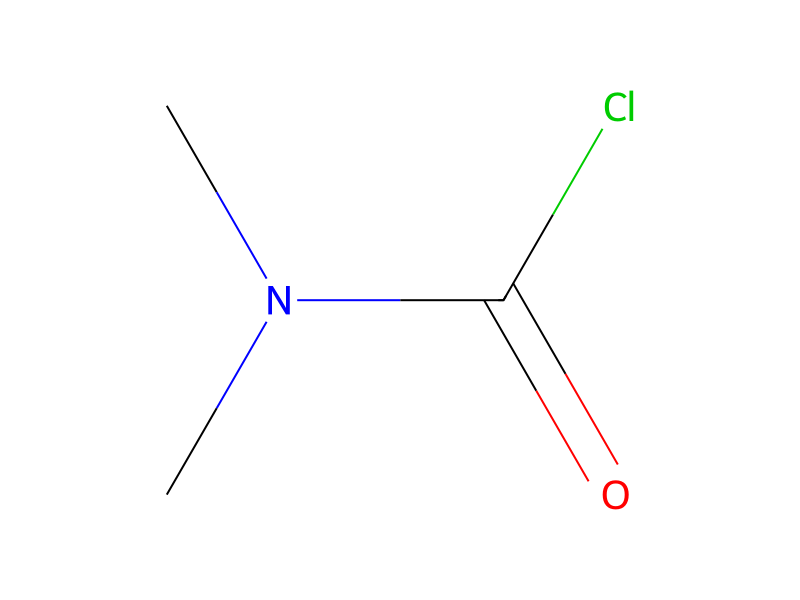
Dimethylcarbamoyl Chloride → N,N-Dimethyl-N'-(5-methyl-1,2-oxazol-3-yl)urea
Reaction equation

[NH2:1][C:2]1[CH:6]=[C:5]([CH3:7])[O:4][N:3]=1.[CH3:8][N:9]([CH3:13])[C:10](Cl)=[O:11]>N1C=CC=CC=1>[CH3:8][N:9]([CH3:13])[C:10]([NH:1][C:2]1[CH:6]=[C:5]([CH3:7])[O:4][N:3]=1)=[O:11]Participants
Reactant 2

Product 1

Reagents, catalysts & solvents 1

Procedure
To 3-amino-5-methylisoxazole (490.6 mg), pyridine (3 g) and dimethylcarbamoyl chloride (1.18 g) are added, and the resultant mixture is stirred at 60° C for 5.5 hours. The pyridine is evaporated under reduced pressure. The residue is mixed with water (15 ml), adjusted to pH 1 with 5% hydrochloric acid and shaken with chloroform. The chloroform layer is evaporated to remove the chloroform, The residue is mixed with 1.5% methanolic sodium hydroxide solution (25 ml) and evaporated. The residue is extracted with chloroform again. The organic layer is washed with water, dried over anhydrous sodium sulfate and evaporated to remove the chloroform. The residue is chromatographed on a thin layer of silica gel to give 1,1-dimethyl-3-(5-methyl-3-isoxazolyl)urea (0.4735 g) as crystals melting at 150.5° to 151.5° C. The yield is 56%.
Workup
- customThe pyridine is evaporated under reduced pressure
- additionThe residue is mixed with water (15 ml)
- customThe chloroform layer is evaporated
- customto remove the chloroform
- additionThe residue is mixed with 1.5% methanolic sodium hydroxide solution (25 ml)
- customevaporated
- extractionThe residue is extracted with chloroform again
- washThe organic layer is washed with water
- dry with materialdried over anhydrous sodium sulfate
- customevaporated
- customto remove the chloroform
- customThe residue is chromatographed on a thin layer of silica gel
Sources & evidence
- ORD record
- ord-ede7c1c1d86f4cb290291e09e0e9485c
- Source dataset
- uspto-grants-1977_12
- Patent number
- US04062861
Reaction notes
Loading…